The Nightshirt Sightings, Portents, Forebodings, Suspicions
The Real Infinite Improbability Drive: Cloaking Devices, UFOs, and ESP
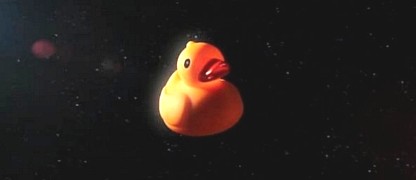
Away in front of them a huge white dome that bulged against the sky cracked down in the middle, split, and slowly folded itself down into the ground. …
Beneath it lay uncovered a huge starship, one hundred and fifty metres long, shaped like a sleek running shoe, perfectly white and mindboggingly beautiful. At the heart of it, unseen, lay a small gold box which carried within it the most brain-wrenching device ever conceived, a device which made this starship unique in the history of the galaxy, a device after which the ship had been named—The Heart of Gold.
“Wow”, said Zaphod Beeblebrox to the Heart of Gold. There wasn’t much else he could say…
More and more reports are emerging about advances in cloaking technology. Since Star Trek we’ve all been familiar with the concept of camouflaging objects in space; last week there was news about, of all things, “time cloaking,” although the principle was evidently first demonstrated at MIT a few years ago. A time cloak causes photons to halt before an event and then continue on their way afterward, like cars stopping for a pedestrian at a crosswalk, effectively (and mind-blowingly) making it as though the event/pedestrian never happened.
 These advances are coinciding with an interest in “cloaked UFOs,” and it might be worth asking if there could be a connection between cloaking and the famed mysteries of UFO propulsion. So here’s another in my series of what might be called “unthinking antigravity”—attempts to escape the usual conceptual boxes of ufology: What if cloaking is not just a defensive camouflage mechanism but is actually an intrinsic part of how UFOs (and someday, our own space-and-time vessels) get around?
Douglas Adams’ “Heart of Gold” (from The Hitchhiker’s Guide to the Galaxy) provides a possible clue to the quantum mechanical reasons why an advanced hyperdrive might actually be tantamount to a cloaking device.
“…the most brain-wrenching device ever conceived”
The Heart of Gold is powered, Adams writes, by improbability itself:
The Infinite Improbability Drive is a wonderful new method of crossing interstellar distances in a few seconds; without all that tedious mucking about in hyperspace. As the Improbability Drive reaches infinite improbability, it passes through every conceivable point in every conceivable universe almost simultaneously. In other words, you’re never sure where you’ll end up or even what species you’ll be when you get there. It’s therefore important to dress accordingly.
The question becomes: How do you reach such a state of improbability? Obviously, the same way Schrödinger’s cat does: by hiding in a box. Adams never reveals the brain-wrenching secret hidden at the heart of the Heart of Gold, but it must be a cloaking device.
 According to the “Copenhagen Interpretation” of quantum mechanics (or at least some interpretations of the Interpretation), the collapse of a particle’s wave (probability) function requires that there be an observer to measure (localize) it. In plainer terms: A state of affairs needs to be seen by someone in order to become real or actual. As long as waves/particles (or by extension, all the particles making up a starship) can’t be seen and measured, they theoretically remain in an indeterminate state, all possibilities (and all possible locations in spacetime) at once.
What if UFOs somehow expand their “spacetime potentiality” by shielding themselves from observation and measurement, using a powerful cloaking device, effectively turning themselves into Schrödinger’s cat?
This idea occurred to me in a completely unrelated context, psychic healing. In his excellent book Limitless Mind
That sensation you just experienced was the telepathic awareness of a million materialist physicians crying out in shock and rage at the implications of Targ’s suggestion. I’m not sure what I think of this idea when it comes to approaching health and illness, but the notion seems like it could make good sense of UFO locomotion: A fully cloaked vessel could exist temporarily as a vast wave function in some nonlocal, indeterminate, probabilistic (or possibilistic) state of uncertainty from which it is therefore possible to reemerge anywhere, anywhen, and in any form—just like Zaphod Beeblebrox’s mindbogglingly beautiful spaceship.
 There’s an important entailment of this hypothesis that could make sense of some peculiarities of the UFO phenomenon: While a vessel in transit would temporarily exist as an unmeasured and unmeasurable fan of possibilities, it would actually require an external observer to be able to materialize (or become actual) at its destination. In other words, the observer/witness could be an intrinsic part of UFO travel, not an accident.
Could this be why so many UFO sightings seem to be almost staged? Could this account for all the bright lights? Might a witness or bystander actually be essential for a UFO to “land” in our reality?
Uncertainty: UFO and ESP Fuel
Famously, the head of Lockheed’s Skunk Works is reported to have hinted that UFO propulsion is based on ESP principles. Nonlocality (the interconnection of everything) has been the assumed interpretation of that statement, but according to the hypothesis I’m suggesting, it might really be uncertainty—since uncertainty is the state a shy cat or fully cloaked starship would be in quantum-mechanically. (With all due respect to Adams, we’d probably need to rename his invention an “infinite uncertainty drive.”)
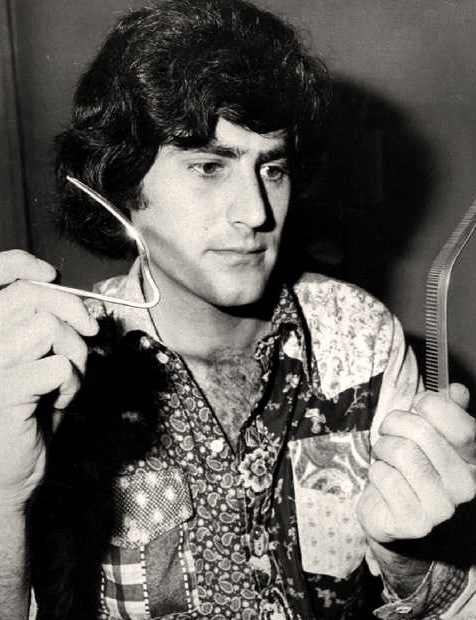 Uncertainty happens also to be intrinsic to psychic phenomena, and it is a constant frustration for those who would seek to pin these phenomena down and study them scientifically. Uri Geller was a prime example of this. As Jonathan Margolis shows in his excellent biography
To be fair, Geller himself was always a bit uncomfortable claiming those powers as his own; they seemed to happen around and through him, and there was always something “tricksterish” about it. Either Geller himself instinctively knew, or the powers working through him knew, that measurement was the enemy. I’m persuaded his “powers” were not a fraud, as James Randi has made his career claiming, but they did only function within an atmosphere of unpredictability and uncertainty—or they even fed on it—and Geller was not above using standard stage-magic legerdemain to help preserve that (a common phenomenon known as “mixed mediumship”).
According to Margolis, Geller has actually always been drawn to those who doubt him, and this is true of other magic men throughout history: They have always functioned and even thrived within an aura of uncertainty, and often even entered into their profession via determined skepticism. Many shamans, for example, begin their careers as debunkers; they then learn not only the “tricks” of the trade, but also the genuine paranormal power cloaked and even protected by that trickery. Because uncertainty is intrinsic to the shaman’s power, there will always be James Randis throwing skeptical stones. The Gellers need the Randis as much as the Randis need the Gellers. It’s the Trickster logic of anything that draws from uncertainty’s well.
Including the Unknower in the Unknown
But the poetic cliche that science kills the world of magic is also precisely right: Science may be an encroachment on this other “quantum” form of prediction and control, and while interdependent in one sense, they are also inherently incompatible. I say “forms of prediction and control” and not “ways of knowing” because shamanic magic (to put a label on it) is really a path that depends upon strategic unknowing.
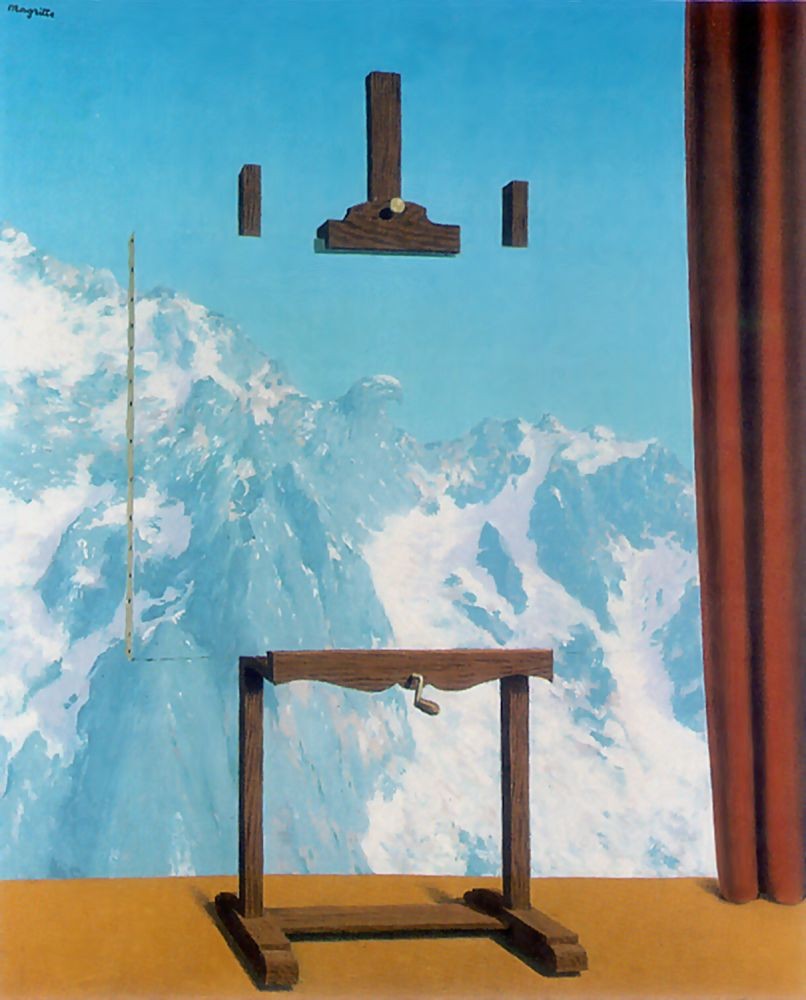 Suggestive clues are many here, and include the well-known power of nonconceptual and wordless thinking advocated by mystics and meditators, the hermetic value placed on silence and secrecy, and the observation by modern shamans (e.g., remote viewers) that “things that have been hidden shine like beacons in psychic space,” as star SRI psychic Pat Price put it. What is lost in the inability to know a thing with certainty is a gain when it comes to visualizing a thing in the fuzzy realm of the uncertain-but-probable.
The reverse ought also to be true. If I were Russell Targ and Hal Puthoff in the 1970s at SRI, I would like to have performed the following experiment: Ask Price or Ingo Swann to remote view the fate of photons in a double-slit experiment. My hypothesis: They would not see the outcome (i.e., the famed collapse of the wave function), but instead would see a gray indeterminacy or a multistable flicker of possibilities, like a visual duck/rabbit … because clairvoyance is not the kind of observation uncertain waves/particles are looking for in order to land in the actual. (That’s just a hunch.)
In any case, if we were to formulate a theoretical principle here, it would be something like this: That “the paranormal” encompasses phenomena that for one reason or another, intentionally or accidentally, are recalcitrant to measurement/observation, and this observation-resistance either gives them their power or is involved in their power, on the model of quantum decoherence and the collapse of the wave function.
Whether or not there are really such things as “cloaked UFOs” isn’t really the point: They are a useful imaginary tool for probing the boundaries of thought, and the meaning of occult. That vexingly polyvalent term, which simply means “hidden,” is on one hand just a bookstore label that unifies diverse uncertain and tricksterish topics under its uneasy umbrella. With all those topics, there’s an ambiguity as to whether the thing is being hidden from view because it would be persecuted otherwise (e.g., witchcraft), whether it is overlooked because no one takes it seriously (e.g., UFOs and ESP), or whether it has to be concealed in order to function.
In European alchemy, for instance, there has always been a suggestion that the cloaking of secrecy was somehow intrinsic to its power; for the great 20th-century adept Fulcanelli, the massive subterranean foundations of French cathedrals and the black Madonnas often found down in those crypts symbolized the dependence of the Great Work on obscurity: “Real, but occult, power, which is exercised in secret, develops in the darkness, toils without respite in the deep foundations of the work.”
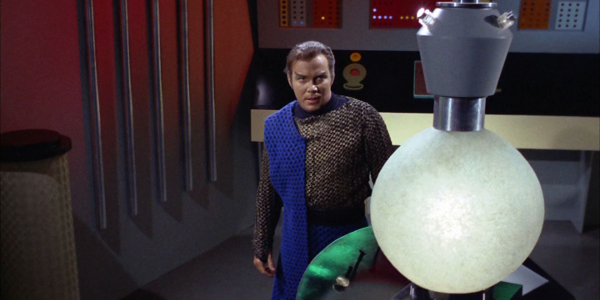
Consciousness Inside-Out: Wormhole UFOs, the Hill Abduction, and Interstellar
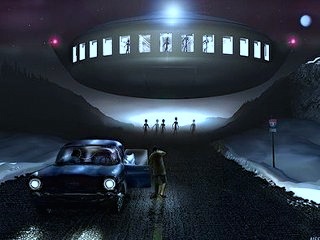
Jacques Vallee has been saying for years that our materialistic fetishism for the nuts-and-bolts secrets of UFO propulsion is a block on our imagination and a hindrance to scientific understanding of the phenomenon; there are countless other possibilities besides ‘alien spaceships propelled by antigravity.’ Thinking differently about how our visual system interprets anomalous phenomena can help illuminate some of these other possibilities. Special effects can be useful in this effort, producing breakthroughs in how we see the problem in our mind’s eye.
For example, the idea of portals and gateways
If this is the case, the visible exterior of a “flying saucer” might actually be the inner chamber of a wormhole-making machine.
Innies That Look Like Outies
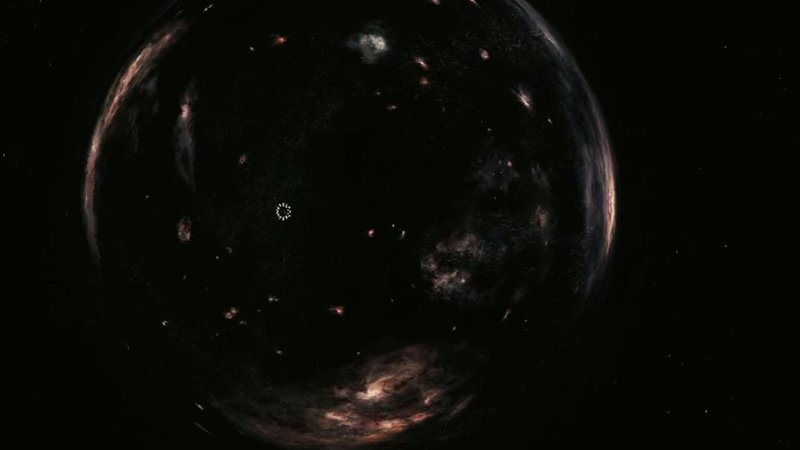 Interstellar showed how a wormhole in space would look from a distance a lot like a glass Christmas tree ornament (right). The refracted light of stars seen through and beyond it would be interpreted visually as reflected light, as off a shiny object. As you approached and lost sight of the “rim” in your peripheral vision you would see that there was actually no surface and that the convex appearance had been an optical illusion.
A wormhole created in the high-tech laboratory of some future “Wormhole Inc.” would look very different. It would not show stars beyond it but simply the insides of the machine or chamber generating the wormhole. Thus, it might look metallic, perhaps something like a big vacuum chamber in a physics lab turned inside-out. Visually, from a safe distance, it would appear solid and round because we would interpret its surface as convex (pushing toward us). Only as you approached it—or as it approached you—would its perspective seem to distort and your senses might finally realize you were seeing into the insides of a machine or chamber of some sort.
More likely, of course, you would be too confused, frightened, and upset by the encounter to “realize” anything at all. You would lack any precedent in your experience for such a phenomenon—or even any sci-fi special effect to relate it to.
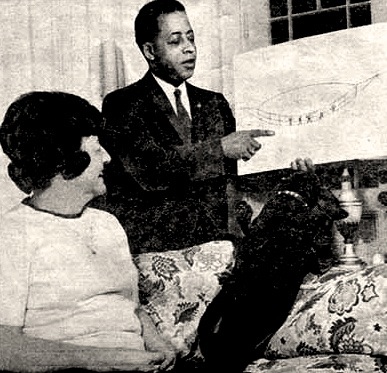
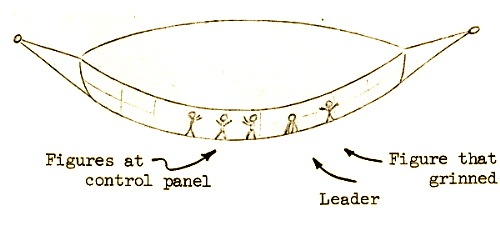 Consider the classic archetypal flying saucer or lozenge with windows around the rim, maybe with occupants looking out, as described by Betty and Barney Hill after their famous abduction (left). This seems like what a circular wormhole-creating chamber with observation windows looking into it might look like. The figures “watching out the windows” of the flying saucer could actually be proud technicians peering into their wormhole chamber.
Wormhole Inc.
Critical ufologists like Mac Tonnies have pointed out the absurdities and inconsistencies in the Hill case—the theatrically presented star map, the not-super-high-tech (or spaceship-like) exam room, and so on. Abductees often describe interiors that are bigger on the inside than the outside or that don’t correspond well to the tightly packed and neatly arranged environment one would expect of a spacecraft. It has often been suspected that the examinations (if real) are actually taking place at an earth-bound facility somewhere, not on the “saucer.”
 A wormhole generated in, and projected from, some large, land-based facility (e.g., on earth, in the future, or on another planet) would explain a number of things. It would eliminate the problem of packing enormous amounts of energy into a moderately sized object: If what looks like a saucer is really just the Wormhole Inc. laboratory turned inside out then it need not contain anything—no people, and no power plant.
I am momentarily ignoring, of course, the vastly greater energy needed to create a wormhole, versus levitate a 30-foot metal disk. Current physics grants wormhole technology to Type-III civilizations capable of harnessing the energy of their whole galaxy—quite a big power plant—so my thought experiment is presuming some unforeseen technical leap or discovery making the process much more convenient.
If we do grant such a leap enabling lab-made wormholes, the theory could perhaps also help account for the laser-pointer-like motion of UFOs, which suggests they could be something insubstantial like an image being projected and stabilized in the air and not physical, massive objects actually flying. Whereas their frequent appearance on radar would make the volumetric hologram theory unlikely, a lab-made wormhole inserted into our airspace would indeed produce a radar return, albeit perhaps slightly distorted or displaced—the radar waves would simply bounce off the interior walls of the wormhole chamber and right back out. (In contrast, a space wormhole wouldn’t appear on radar because the radar waves would have nothing to bounce off of.) But the hole itself would have no mass, as the mass is all back at the lab.
 A wormhole generator also more realistically solves the more fundamental “relativistic” problem: How to bring people (e.g., relatives) to you instead of going to them—because as grown-ups realize on occasions like Thanksgiving, it’s more fun being a host than a guest. A wormhole enables you to interact with distant objects and people from the comfort of your own laboratory, not have to pack yourself into a cramped ship and go on an annoying or dangerous journey. We should bear in mind that interacting with or manipulating unwitting guests like the Hills is probably the least of a wormhole generator’s many fabulous uses.
The World Turned Inside-Out
Beyond depicting a solution to “nuts and bolts” problems of long-distance travel, a wormhole also shows us that inside and outside are relative—one observer’s outside is another observer’s inside.
Although Interstellar was disappointing in some ways (like a clumsy script full of expository dialogue, as well as pretty lackluster spaceships), it depicted wormhole travel really well, and it also spectacularly depicted exactly the future-intervention-via-tesseract theory for paranormal phenomena that various sci-fi writers (from Madeleine L’Engle to Philip K Dick) have groped to convey in their fiction. Sometimes you need new special effects to visualize problems and produce an “aha” experience; when that happens, new solutions and new theories appear more readily.
For one thing, we are at a crux in our science and our culture when a new model is desperately needed to think about the relationship between consciousness and material reality. Much as I’m sympathetic with those who privilege consciousness against materialistic reductionism, I think a more nuanced and nonhierarchical relationship between mind and matter must be possible. A wormhole-UFO could provide such a model.
Such a beast helps us visualize, for example, how material reality is just what consciousness looks like from the outside. Matter itself isn’t the illusion, in other words—nor is consciousness. The illusion may simply be the “convex” appearance of the material world.
The word “exist” comes from the Greek eksistere, “to stand forth.” As mystics from time immemorial have insisted, the material world is a manifestation of consciousness—the self-world continuum experienced passively, as observed, rather than actively, as observing. These two aspects pass from one to the other at certain mysterious boundaries—in dreams, at death, and in paranormal phenomena (such as UFOs) that turn our outside into an inside (or vice versa) without our quite being aware how we made the passage.
Psi of Regret: Pitfalls of Prophecy from Patanjali to Paul Muad’Dib

It’s been over twenty years since I last read Dune, but inspired partly by the phenomenal documentary Jodorowsky’s Dune, I recently re-read Frank Herbert’s masterpiece and a few of the sequels. Although the latter are uneven, I need hardly say that Dune itself holds up magnificently. It is still the one novel I would put in the hands of a teenager—even more than anything by Tolkien (even though Tolkien’s “literary worth” is probably greater)—because of the priceless seeds the book planted in me when I was the age of its main character, Paul. (For instance, “the first lesson of all was the basic trust that he could learn. It’s shocking to find how many people do not believe they can learn …”—that’s a powerful message every adolescent needs to hear and I am ever thankful I paid attention; and the “litany against fear” was incalculably important to me.)
Although the Dune books are about many things, it is sometimes forgotten (amid praise for Herbert’s world-building and his anticipation of American-Mid-East relations in the 70s and beyond) that they are significantly about seeing the future; the sequels, particularly, are basically an extended thought experiment about the siddhi of precognition and the pitfalls of prophecy. Thus I couldn’t help read them now in the light of my interest in psi research and the nexus of science fiction and the human potential movement being newly examined by writers and scholars like Jeffrey Kripal (whose Mutants and Mystics

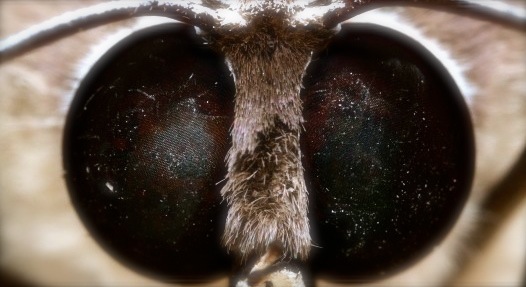 According to Kripal, the notion that humans are on the threshold of the next phase in our evolution and that psychic abilities will be a big part of it is an idea that goes back to Frederic Myers in the late 19th century. Myers likened our nascent psychic powers to the “imaginal characters” or structures present in a caterpillar that hint at its future transformation into an aerial being. This imminent metamorphosis has remained a dominant meme pervading comic books, of course, most famously in the X-men, not to mention sci-fi visionaries from Alfred Bester to Herbert to Philip K. Dick.
But despite the democratizing impulse in modern writers on psi, like Russell Targ and Dean Radin, who emphasize that we all have latent psi abilities that we can develop if we choose, it is important to bear in mind some important social and maybe even evolutionary reasons why certain forms of psi—especially precognition—are not already more widespread than they are, why they may actually not be part of our species’ birthright, and why they may even not be such a great idea in the larger scheme of things. Herbert keyed in on some of these reasons in his novels; the ancient yogis like Patanjali keyed in on others.
Muddying the Waters
A rarely considered pitfall of prescience that Herbert used brilliantly as a plot device in Dune Messiah is that if more than one individual can see the future, it tends to negate both of their abilities. In a conspiracy to assassinate Paul Muad’Dib, the plotters involve in their plans a Guild Steersman, whose spice-induced oracular vision effectively cloaks the whole affair from Paul’s mental futurescape.
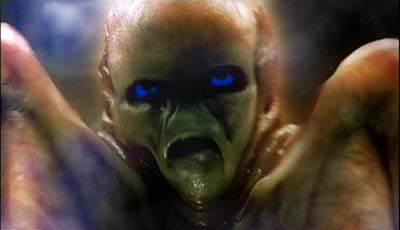 The reason for this effect is simple when you think about it: If precognition is not seeing the future as such but seeing some vague and shifting topography of possibilities in a butterfly-effect universe (as Herbert sort of characterizes it), then the possibility and usefulness of foresight become radically limited once it becomes shared by others. A glimpse of the landscape of future possibilities by one freely willed being capable of altering that future must inevitably muddy the temporal waters for other precogs/prophets.
When you start to multiply the number of people with oracular vision (and thus freedom to alter what they see through even minor actions), then the seen, malleable future breaks down rather quickly. Even a few rival seers would tend to negate each others’ powers; if a whole species could exercise prescient abilities, the time stream would become a hopelessly opaque and deceptive mush. In such a state of affairs, there would clearly be diminishing utility in being able to see the future at all. You would be better off blind to all but the present and past, so as not to be distracted by prophetic information that was probably wrong.
Restraining Bolts
There is a paranoid belief that someone or some force is keeping us down psychically, keeping us unaware of our true natures and working to thwart the development of our true ESP capabilities. Remote-viewing inventor Ingo Swann confided to Jacques Vallee in 1979 that “There’s a non-human system that keeps the human race under observation to make sure it doesn’t develop psychically … You become aware of the barriers erected by this system as soon as you try to develop your psychic abilities.” This seems to be a standard Gnostic suspicion, echoed in comic book mythologies: Extraterrestrials or Archons fear our psychic potential and have thus installed some kind of restraining bolt in our minds. The sense of some ancient psychic lock being blown off or removed, opening floodgates of forbidden information, seems like a common sentiment among the psychically awakened—for instance Philip K Dick in his 2-3-74 experience, or the Scientology-steeped remote viewers at SRI (it’s all about “clearing blockages”).
But evolution itself (social if not biological) provides ample reason why such mutations or experiences may not herald some new evolutionary phase in human development and why the forces of psychic inhibition may be far more mundane (and even beneficial) than Swann suspected. Because of the Dune Messiah logic I mentioned, there may be completely natural, homeostatic mechanisms working to limit our cognitive receptivity to future events or possibilities, causing such a sensitivity to atrophy and be selected against in the population. There would be social pressures not to be precognitive, and we might even evolve some kind of biological blinder mechanism to block it out, on the model of Bergson’s reducing valve.
 I don’t have any insight into what the biological/genetic basis for precognition or its inhibition might be, but the social mechanisms inhibiting foresight and prophecy are plain enough. Ostracism, persecution, and violence against people accused of witchcraft and sorcery are still endemic in many societies and surely go back to the dawn of history. Witch-killings are still rampant in many parts of the world. A leader of a Papua New Guinea village I visited in the early 1990s had spent time in jail for disemboweling a suspected sorcerer with a machete; it still happens all the time in that country. It doesn’t matter that in most such cases—as in Europe in the Middle Ages or in early America—“witchcraft” was a broad brush with which to tar all kinds of personal enemies and social outcasts, such as the old, the poor, and women. The point was, it was a serious deterrent to deviance of all kinds, including psychic deviance.
Societies provide strict, narrow social channels to a career in prophecy, such as the accepted shamanic paths that exist in traditional cultures, and it’s a dangerous career: You better be damn sure you are perceived as using your powers for healing, not harming. The threat of ostracism and violence must act as a powerful check on “developing your ESP abilities” (i.e., having truck with the spirit world) if you live in a traditional community.
In our enlightened society, psi-inhibition takes less disturbing forms, namely rabid skepticism and materialism and ridicule of the paranormal. But even if it is less violent than traditional social controls, such ridicule is still a very powerful deterrent. Writers encouraging people to develop their remote viewing abilities, like Targ, emphasize that simple “permission” to remote view is a crucial first step. Even those intellectually persuaded of the possibility and eager to learn often have massive unconscious inhibitions that get in the way.
Thus, there is no need to invoke non-human, extraterrestrial, or Archonic interference to explain lack of widespread psi ability: Social expectations that psi not only does not exist but that it is actually ridiculous do a fine job of keeping people from peering into the future.
Prophet Motives
There’s an interesting kicker of course: The more “beyond the pale” psi and prophecy become, the more effective they would be for those able and brave enough to exercise these abilities. Even if the barriers against psi were rooted in our genes, chance and mutation would dictate that enhanced precognitive ability would arise from time to time; although there could be no group, society, let alone species of prescients, there might be a rare individual, a mutant who saw the future and capitalized on it. A prevailing present- and past-mindedness in the masses would create a relatively unmuddied futurescape navigable by a gifted individual able to capitalize on the herd’s future-blindness. Indeed, through this evolutionary logic, those who benefit the most from the social suppression of prophecy would be the prophets themselves.
 There are good analogies to this in evolutionary biology, one of them being sociopathy. Because we are socially dependent animals and society is built on trust, humans have evolved to essentially trust each other. It’s a very sound long-term evolutionary strategy, but it also makes us vulnerable to occasional manipulators who are able to cynically capitalize on that trust. Such individuals only arise at relatively low levels in the population, because when there are too many untrustworthy people in a community, people stop trusting, and the community breaks down. But when they arise, they tend to rise to the top. (Research shows many CEOs and politicians are sociopaths, for example.)
Prophecy might work the same way, as a “frequency dependent, socially parasitic strategy” (to quote George Dvorsky in an article on sociopaths). Despite the “democratizing” impulse of contemporary psi teachers and enthusiasts, some of these talents may only work if they are rare and most people don’t practice them or don’t believe in them. There are various ways in which the paranormal erects a barrier between the herd and an elect, and this is one of them—another variant of what I call the “anamorphic wedge” that seems to operate in other domains like UFOs.
I’ve argued previously that there’s a dark elitist undercurrent to sci-fi Gnosticism that can be seen plainly in its most famous manifestation, Scientology: L. Ron Hubbard was the Ayn Rand of psychic human potential, preaching pure selfishness with a sci-fi twist. From what it is possible to glean of its methods, I don’t doubt their efficacy. It was in an out-of-body experience during early Scientology training that Pat Price’s formidable psychic abilities, dormant for a half century of life, awakened: “I was asked to sit down and look at some other guy for period of time and do nothing. After about three minutes I found myself outside of my body, looking at him looking at me. It was very interesting.” (John L. Wilhelm’s excellent 1976 book The Search for Superman is a great resource on Price, Swann, and the SRI work with Uri Geller.)
The superpower benefits that arise through Scientology training may not be accidentally related to the clear and obvious drawbacks of that lifestyle: Namely, intellectual isolation and social ostracism as a result of being, lets face it, kind of an asshole. Scientology training includes exercises (like the one Price mentioned) designed specifically to break down or cleanse the participant of social anxieties and emotions that we possess for a reason, thus turning the “operating Thetan” into an intense, intimidating, “aggressive” savant who may not thrive outside the company of other Scientologists. Real X-men could potentially look a lot like them: out of touch and megalomaniacal, but with some authentic supernormal abilities as a kind of grim consolation prize.
Fear is the mind-killer…
Despite lifelong skepticism, I have become persuaded of the reality of psi in general and of precognition in particular. Once you take even the slightest interest in the subject, fate provides ample confirmation in the form of uncanny premonitions and synchronicities. Having followed J.W. Dunne’s protocol in An Experiment with Time, I have confirmed to my own satisfaction (which seems all anyone can ever hope for in parapsychology) that his thesis is correct: In any given week of faithfully recorded dreams, a consistent minority of dream elements encode future experiences, usually of the subsequent day but occasionally farther out, exactly the same way the majority of dream elements encode recent past experiences—and through exactly the same “art of memory” logic I have described elsewhere. In dreams we are remembering the future as well as the past. Hypnagogic imagery and voices are also a rich source of precognitive material, and plain-old remote viewing of tomorrow’s New York Times can also produce interesting results.
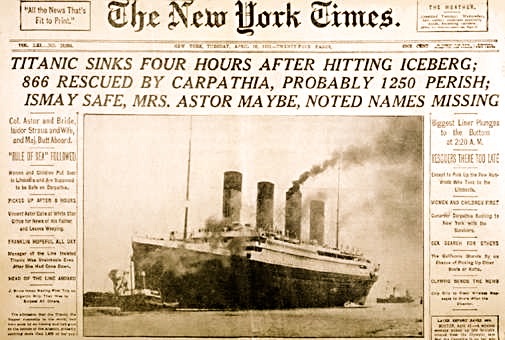 Invariably in my case, these bits of future information are fragmentary and useless from the standpoint of planning or guidance. I’m no prophet—and I’m not sure I’d really want to be. Another “inhibitory” function I’ve discovered in my venturing imperfectly down the psi path is simple existential fear. While omnisicence and expanded consciousness sound totally awesome to my inner 10-year-old, I’ve discovered that my outer 47-year-old is deeply fearful of learning too much about the future. There are too many dark terrors that objectively lie in wait for us all—illness and death of self and loved ones are biggies—and the temptation to dwell unproductively on ominous signs (like a strange cough or unfamiliar pain) is great enough at times without the added burden of trying to decipher scary symbols and portents gained through psi channels. Among the siddhis described by Patanjali is the yogi’s ability to see his/her own death. No thanks.
Because the energy of psychic phenomena is trauma (as Frederic Myers discerned in the 19th century), it makes sense that death and destruction would be dominant themes in our prophecies. And sure enough, the bulk of my precognitive dream material does concern something at least slightly negative, usually just uncomfortable or unpleasant social experiences but also news of crimes, disasters, or death. This focus on the negative gives rise to an ironic and unwholesome logic: The eagerness for psi to work or to confirm your own powers causes one not only to focus on negatives but even at times to hope for them—for example, having a strange dream about a certain celebrity and then eagerly checking some news site to see if they died or have been involved in some scandal. Obviously, “eagerness to find out someone died” is not at all a congenial frame of mind to be in if you aspire to be a spiritual or positive person.
Thus I think there really is some way in which precognition is “toying with dark forces,” although it isn’t anything as grandiose as “opening up doorways to other worlds” or awakening evil or Tricksterish energies (even if those are real too). It’s simply a matter of reinforcing unwholesome aspects of the ego—plain old negativity, which is bad karma (and unhealthy) no matter how you look at it.
I suspect all these factors may have played into ancient teachers’ disinterest in the siddhis and into modern teachers’ reluctance to discuss them. Patanjali warned not to get attached to superpowers in your meditative practice, and he’s not just talking about showing off (as Radin suggests in his book Supernormal). Attachment itself is the root of suffering; attachment to psi may bring its own unique sufferings and doubts that are simply not wholesome to harbor, such as those I’ve mentioned. So, while the 10-year-old me is incredibly glad that the paranormal and supernormal are gaining legitimacy through the work of Kripal, Targ, Radin, and others, I also would hope that we not lose sight of our basic humanity in our quest to become superhuman. Sometimes it’s also awesome to be (merely) normal.

To the Unified Field (via Twin Peaks): David Lynch’s Paintings
“We live in a world of opposites, of extreme evil and violence opposed to goodness and peace. It’s that way here for a reason but we have a hard time grasping what the reason is. In struggling to understand the reason, we learn about balance and there’s a mysterious door right at that balance point. We can go through that door anytime we get it together.” —David Lynch
Many fans of David Lynch’s films are probably aware that he started as a painter and has continued to work in that medium all his life. (For example, they may have glimpsed him at work in his atelier in the documentary that accompanies the Inland Empire DVD.) But it has been frustrating trying to find examples of his paintings and drawings because there has been no single book comprehensively showcasing them. Finally, David Lynch: The Unified Field
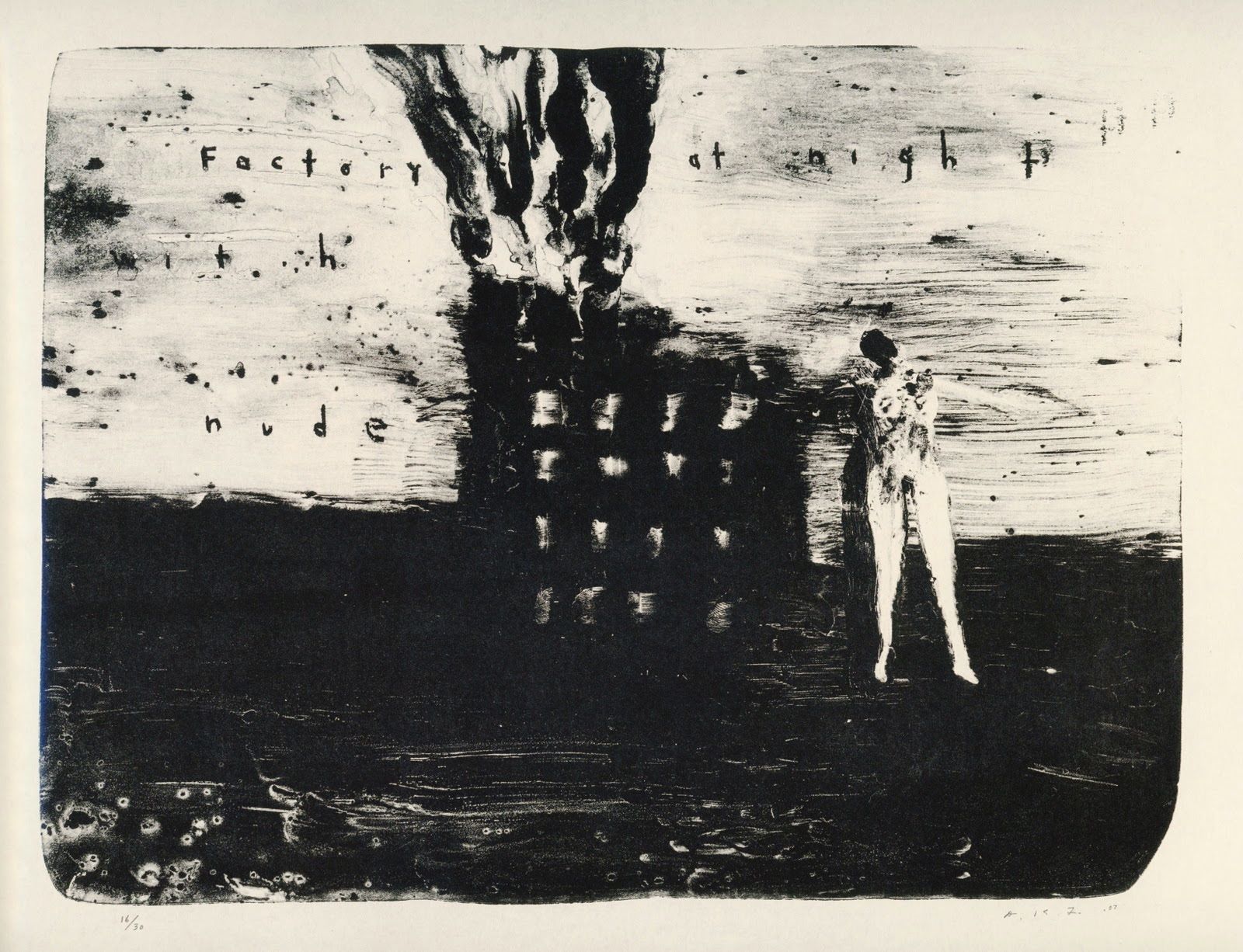 It’s a gorgeous book, with an excellent long essay by Robert Cozzolino. It will do much to help Lynch claim the recognition he deserves as a very serious and original artist in a completely different medium from his film and TV work. I’ve spent days thumbing through it already and it is still full of delights and surprises.
Lynch’s paintings, which are bold, childlike and threatening, remind me of Francis Bacon crossed with a dark Cy Twombly, often integrating thickly spackled paint (he mentions feeling the urge to chew on his paintings) with text that is either ultra-banal or psychotic. They reflect many of the same themes that recur in his movies, such as the violence, madness, perverse sexuality, and even paranormal phenomena that can be found when you peel back the surface of outwardly bland American life—or, that become visible at a smaller scale, when you zoom in. But—and this is crucial—they are also often funny; there is typically a sly poke in the ribs underneath the overt threat. (This is what sets him far apart from Bacon, say.)
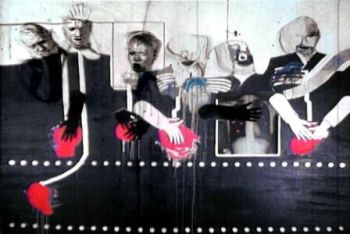 Lynch’s early “moving picture” installation, “Six Men Getting Sick” (which has been recreated for the PAFA exhibition), is like a prototype for many of his later works both in film and on canvas. Six faces imprisoned in a gray-white wall vomit repeatedly; they cannot leave the wall, cannot get up and go to the doctor or even to the toilet, but are trapped in a perpetual materialist hell, purging throughout eternity. It somewhat reminds me of HR Giger’s transhumanist visions of immobilized sentiences trapped and suffering in and from brute matter, although Lynch’s outwardly “ugly” spectacle is far more ambiguous and strange than Giger’s sleek, seductive machine-erotic futurescapes.
On one level, Lynch could be called a painter of matter—of vomit, dirt, muck, rust, and biological decay that step in to co-create the world after humans have contributed their part. He is quoted in the opening essay about being allowed to spend time with corpses in the Philadelphia morgue when he was in art school, and the beauty he finds in “organic processes” that he got from his time spent with his father, who was a specialist in tree diseases working for the Forest Service when he was a child in Montana. Throughout his works, abandoned factories, mud and sores, or the brown stains on the made world, all become sublime.
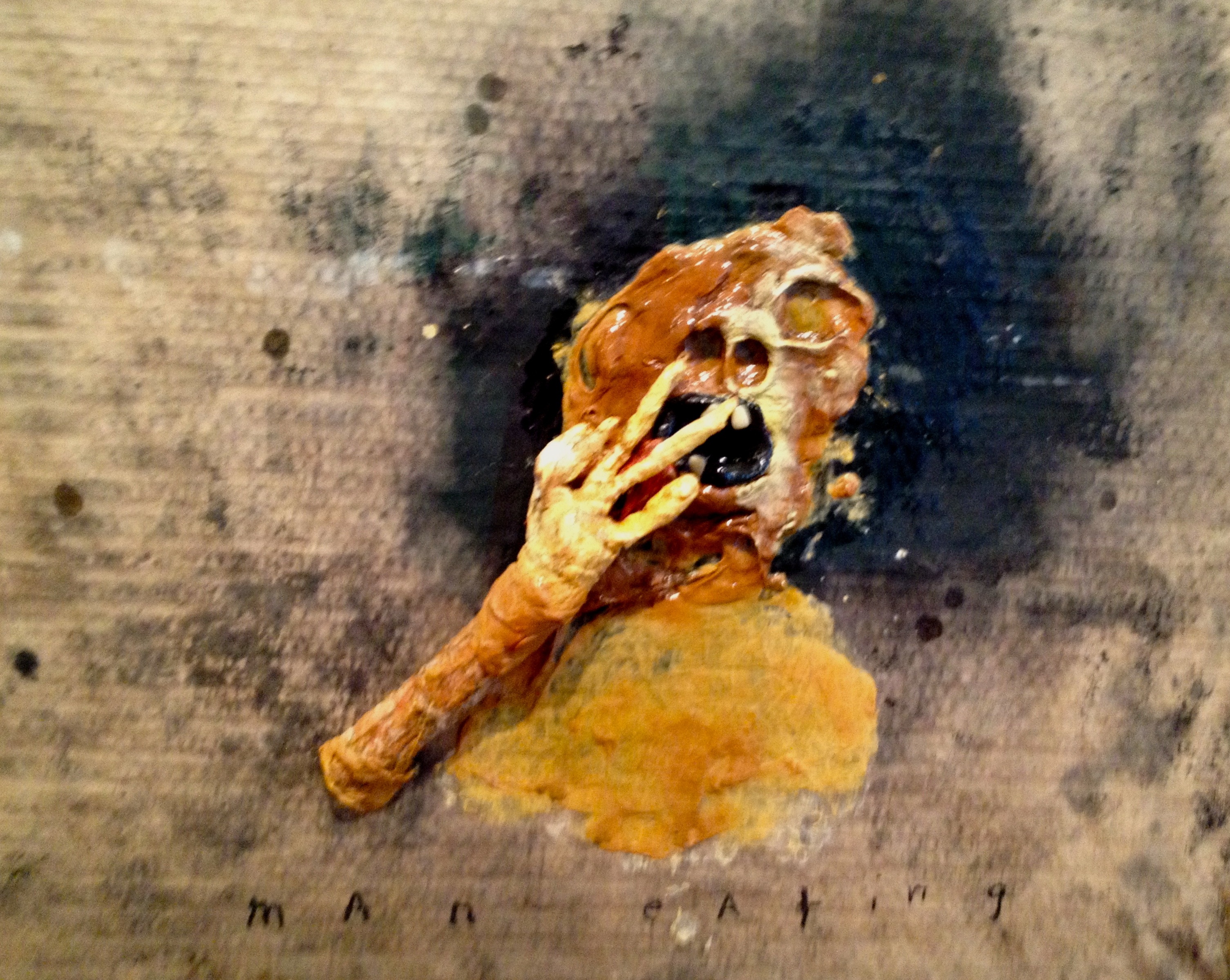 But the matter, even when or especially when it is decaying and messy, is only barely covering over something deeper (or higher). In interviews (and in his brief 2007 book Catching the Big Fish: Meditation, Consciousness, and Creativity
Buddhist writers don’t like to dwell on the mild altered states produced by meditation, preferring that we not get attached to them, but when you detach from your environment even for very brief periods, the world can afterwards take on a funny, mysterious, alive-yet-dead quality that is full of exciting unseen potential. I have noticed for years that after meditating, the world has an altered character that feels distinctly “Lynchian”: Specifically, it feels like the world has suddenly become the world of Twin Peaks—the ordinary, mundane world, but with something added that is a mix of mysterious, humorous, ominous, and subtly exciting. This is why I was so excited to finally get a book of Lynch’s paintings—to see if they had this same quality. I was not disappointed.
One way to think of the subtly altered state of perception I’m referring to is in terms of the “imaginal” that was described by Sufi scholar Henri Corbin: a kind of transfigured surreality overlaid on or coexisting with the everyday world, shimmering in and out of existence. Objects shine funny, oddly, significantly. They wink, ever so slightly. The importance of everything, even just this ashtray or coffee table or lamp, is ever so slightly elevated because through some subtle alteration of frequency, some slight turn of the dial, the shitty bathroom or grocery store or parking lot you happen to be standing in has suddenly become the VIP section of an international spirit-world airport, where one just might encounter other enlightened beings passing through. Even pieces of garbage or dead leaves are “slightly enlightened” celebrities, and you belong in their exciting world.
 I think of this imaginal as a dangerous-feeling and uncomfortable perimeter or no-man’s land that surrounds the blissful Void or Absolute (or “unified field”) that all forms of meditation and mysticism aim for. The ultimate aim is not to linger in this perimeter zone, but you do need to pass through it—and the passage can be really enjoyable and interesting in its own right. This book of paintings confirms for me that Lynch, through his meditation practice, knows about this imaginal no-man’s land and that this is specifically what he is trying to show to us (because the unified field itself can’t be shown). Anything can happen, is about to happen, in this zone, and it pays to be fully awake and alert to the enhanced potential even in the most inanimate of objects and phenomena in it.
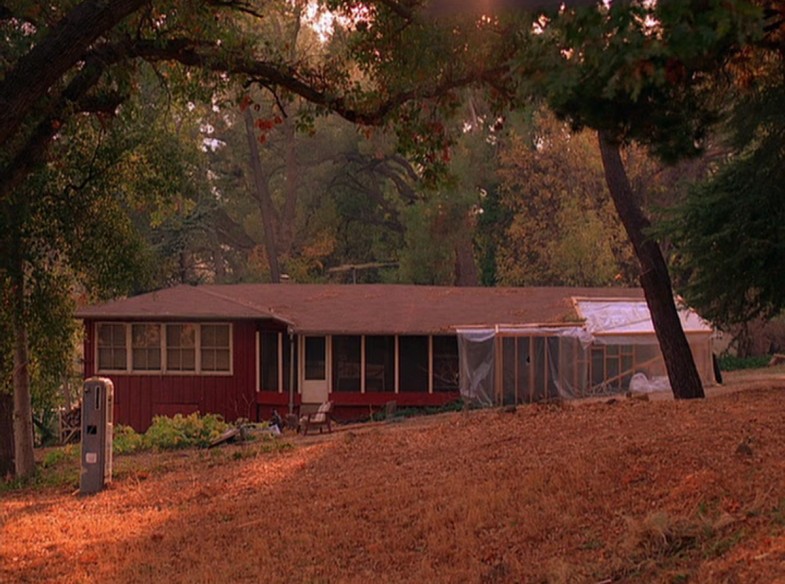
 This imaginal is also a feeling of the world being like a veil. I don’t think it is accidental that Lynch’s film and TV work often includes drapery, most famously the “Black Lodge” of Twin Peaks, where strange shapes float behind red velvet curtains. However, what I actually think of more than drapes per se is the billowing dirty plastic covering the bare two-by-fours in the unfinished home where Shelly Johnson spoons baby food into the dribbling mouth of her ominously comatose husband Leo. If there’s any image from Lynch’s “moving picture” world that gives you a sense of what you’re in for with his paintings (such as the ominous triptych “Pete Goes to His Girlfriend’s House,” above), that would have to be it.
The apparent danger and craziness is not as real as it first appears; it has more to do with our own attitude. Even or especially in his most violent, threatening images, such as “Change the Fuckin Channel Fuckface” (below), or “I Burn Pinecone and Throw in Your House,” you can see Lynch standing back, with a slight mischievous twinkle in his eye, smiling, and you can see that he is actually smiling with you. He wants you to be pulled in, tripped up, as well as held at a slight distance, because this tension has something to teach us, and he wants to help us see it. He is inviting us to ride along with him in his buggy, on an interior journey that he sincerely believes can help everybody.
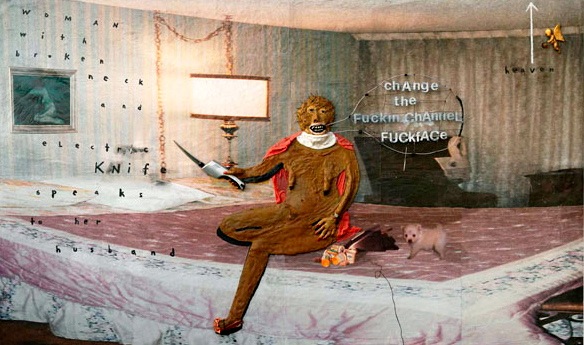 Getting past this imaginal, to the unified field, is not an intellectual exercise of decoding or interpreting hidden meanings: “It’s better not to know so much about what things mean or how they might be interpreted,” Lynch says. “Psychology destroys the mystery, this kind of magic quality. It can be reduced to certain neuroses or certain things, and since it is now named and defined, it’s lost its potential for a vast, infinite experience.” (Half a century ago, Rene Magritte said almost exactly the same thing, reacting against Freudians finding phallic symbols and such in his paintings: “Art, as I conceive it, is resistant to psychoanalysis. It evokes the mystery without which the world would not exist. … Nobody in his right mind believes that psychoanalysis could elucidate the mystery of the universe.”) Yet Lynch’s works bait such interpretation. This baiting and snatching away is part of the point, part of their “M.O.”—which is actually a very Rinzai Zen approach to enlightenment. As I’ve written previously about Mulholland Drive, you must go through the natural impulse to interpret Lynch’s work in order to finally break through the other side, into the irrational and transcendent.
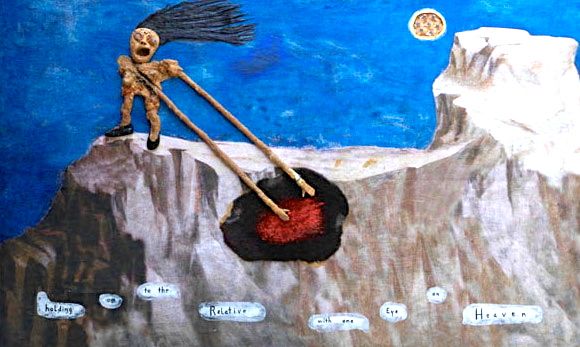
There’s nothing “preachy” about Lynch’s paintings, any more than there is in his movies, but the spiritual message is definitely there if you look for it. One of my favorite pieces in the book is “Holding onto the Relative (with One Eye on Heaven)” (at the top of this post) showing one of his typical disturbing/monstrous brown figures with elongated arms clinging desperately to the pulsating red heart of matter while looking toward the sun and screaming. Lynch’s philosophy I think is made pretty plain here: The frightening dimension is not simply the way things are, but the way we make them because we are afraid of letting go, or are holding on too tightly. Stretched-out arms and “reaching” (as well as arms/hands that are diseased) recur again and again in Lynch’s images, and I think it relates to this idea, and to the opposing forces that we cling to and that threaten to pull us apart.
Ambassadors from Flatland: UFOs and Anamorphosis

It is frequently suggested that UFOs originate in or at least travel through other, higher dimensions. The examples of interdimensional interaction in E.A. Abbott’s classic fable Flatland are often cited to illustrate how such an intrusion into lower dimensions from higher ones might appear. A sphere passing through Flatland (a world with two spatial dimensions and one of time) would appear to the locals as a point that expanded into a widening circle and then dwindled to a point again and vanished (below). Flatlanders (who are all simple shapes like polygons) would be rather astonished at this violation of their common-sense laws: Things don’t just expand from nothing and then dwindle and disappear again.
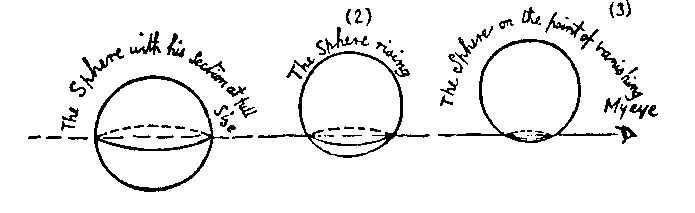 Extrapolating to our 4-D reality (3 spatial dimension and 1 time dimension), this does seem like what many UFOs do: They appear out of nowhere, sometimes expanding and changing shape before disappearing again, as though some higher-dimensional object were transiting our dimensionally challenged world. In this view, the UFO we see at any given moment is just the “section” of a 4- or more dimensional spatial object (e.g., a hypersaucer).
But there is another possibility.
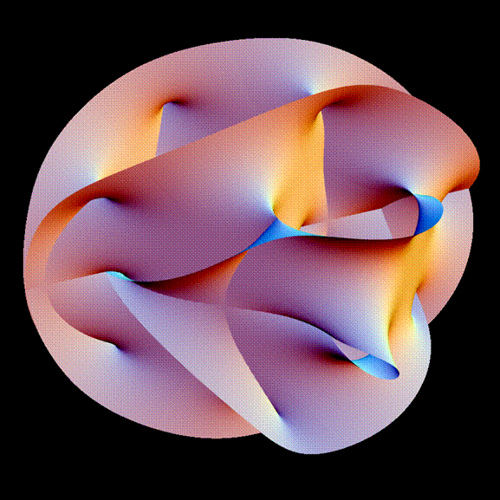 The number of dimensions possible in the universe is hotly debated in physics. I’ve seen the number 11 thrown around a lot, for example, although as I understand it most of these dimensions are thought to be somehow “folded into” the four we directly experience. I honestly don’t know what that means, let alone how to envision it. But another even more interesting theory holds that our purely common sense perception of space and time actually overestimates the spatial dimensionality of our world—that there are actually just two dimensions of space, and that the third dimension (volume) is an illusion.
This is the holographic theory proposed by Dutch physicist Gerard ’t Hooft as an outgrowth of string theory, to explain quantum gravity. Wikipedia describes it this way: “the theory suggests that the entire universe can be seen as a two-dimensional information structure ‘painted’ on the cosmological horizon, such that the three dimensions we observe are an effective description only at macroscopic scales and at low energies.”
Quantum physics is mostly beyond me, I admit, but I do understand general relativity, and doesn’t Einstein’s work already suggests this possibility? As an object approaches the speed of light (gaining mass and energy), it is flattened in the direction of travel, becoming two dimensional; it thus makes some sense that in the “light world” of high-energy particles, two-dimensional space would have to be the norm.
And thus, instead of some kind of enhanced depth, as movie special effects like to portray it, hyperspace would actually be a flat, picture-like place.
From Flatland to Fatland and Back Again
I realize that “painted” is being used somewhat metaphorically in Wiki’s summary, but artistic illusions of spatial depth on flat surfaces (which was partly the subject of my PhD dissertation several years ago) suggest other possible interpretations for how UFOs may actually be interacting with our world—not from higher dimensions but from lower ones.
 Hans Holbein’s 1533 painting The Ambassadors (at the top of this post) shows a typical Renaissance scene of two important men surrounded by sumptuous worldly goods, but jutting across the bottom of the painting is a strange elongated object (left). From straight on, it doesn’t really look like anything—it has been compared to a baguette—and a viewer might even overlook or ignore the anomaly, regarding it as a mistake or a stain of some kind. It is actually an example of anamorphosis—an image only visible from a very oblique angle.
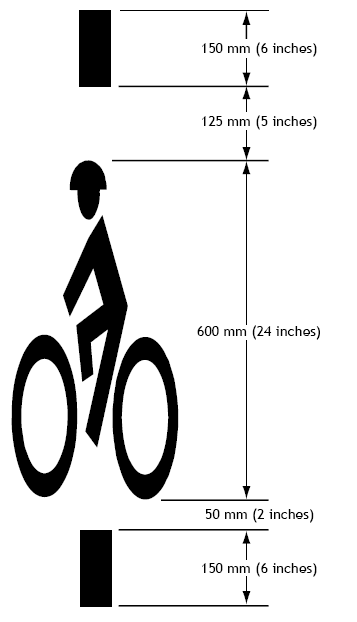 Anamorphosis is widely used nowadays to make lettering and icons on roadway surfaces visible from the steep angle of a driver moving toward them (e.g., the bicycle at right), but it is also a clever way to put hidden images in pictures. When you stand off to the right side of The Ambassadors, up near the canvas, the “baguette” becomes visible as a skull (below). Skulls were commonly included in paintings of the period—especially paintings showing displays of wealth—as symbols of vanitas, or the transitoriness of life, reminding the viewer not to get too attached. We don’t know if Holbein was being deliberately mischievous with his anamorphic skull, but he was certainly showing off his skills with perspective (then a relatively recent invention), since anamorphosis requires considerable advance planning and mathematical precision.
 Could anamorphosis help explain the elusive behavior of UFOs?
The notion of portals or wormholes is popular nowadays in ufology, but the holographic hypothesis raises the possibility that UFOs could be sliding into and out of our (apparently) 3-D world from some high-energy Flatland—like a note slid under a door rather than a person opening it up and stepping through.
High-energy Flatlanders (or perhaps more likely, high-energy exotic technology capable of carrying ordinary 3-D beings from place to place via flat hyperspace) could be nearly invisible or completely non-understandable except when seen from a specific vantage point. This by itself is suggestive, given the fleeting, elusive, hard-to-verify nature of so many UFOs. Who knows?—Our eyes may pass over high-energy beings or technology all the time, but our visual system may generally ignore such anomalies because they make no sense or just blend into their surroundings.
I have long been troubled by the “higher dimensions” hypothesis, partly because it seems so unfair: If higher spacial dimensions reality exist, why would our cognitive faculties be so blind to them? What point is there for us to be only conscious of some of the dimensions available, in contrast to supposed higher dimensional beings who can dip into our impoverished reality occasionally and pity us? I am inclined to think that, with dimensions as with so many other things, less is more, and already our four dimensions are an embarrassment of riches. It may be our visitors (or their technology) that are “dimensionally challenged,” not us.
Somebody could write a sequel to Flatland, called Fatland, about spheres trying to come to grips with the appearance of a circle among them. Inevitably the Flatlander (circle) would appear merely as a line at first, and only widen out into a visible narrow oval and then finally a circle as it drew very close to an observer, but quickly it would dwindle to a mere line again as it receded. From most vantage points it would blend in or at least not be very distinct or salient, and there would be very little agreement among the spheres as to whether there was even anything there at all, let alone what its shape really was.
The Anamorphic Wedge
I want to briefly consider one further aspect of painterly anamorphosis that is suggestive for UFOs—this time in terms of the “control system” hypothesis advocated by Jacques Vallee.
As I said, anamorphic images can only be seen from a very restricted point of view—while one person sees the image, other people standing straight in front of the painting will see nothing, or will not know what they are looking at. Such images thus serve as kind of a wedge between consensus reality and the solitary, privileged viewpoint of the (intended) witness.
There are more aspects to this social-psychological effect of anamorphosis than first meets the eye.
Besides revealing itself to the selected witness, an anamorphic image also, in some sense, “frames” the rest of those viewers in his/her field of vision. Other people are suddenly seen standing there in front of the painting but blindly missing its point or its “true meaning.” In other words, anamorphosis not only displays itself as a hidden secret (thereby making the intended viewer feel special and chosen), it also highlights the ignorance and limited perspective of others in one’s social imaginary. Whether “the ignorance of the masses” is an accurate portrayal or not, it could be part of the intended take-away from a UFO encounter.
What’s more, social separation or isolation or even ostracism of the witness could be the intended effect, not just an unfortunate byproduct, of such an encounter. It’s at least a possibility to keep in mind, that UFOs, whatever they are, could be anamorphic phenomena aiming not only to manipulate or deceive witnesses but also to socially and psychologically isolate them, or separate them from the herd.

Anti-Anti-Tricksters
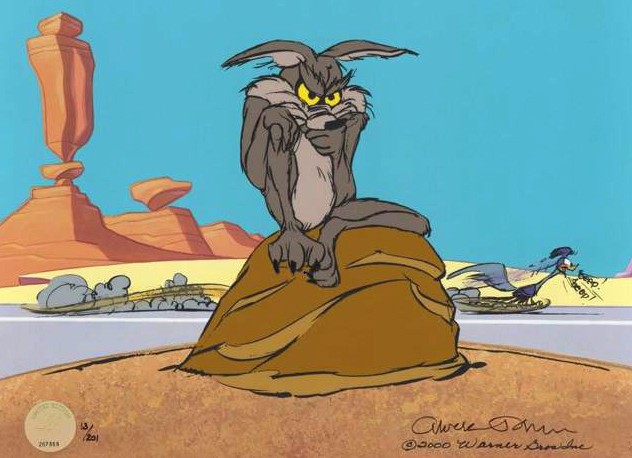
Over on UFO Conjecture(s), Rich Reynolds takes issue with the notion of “The Trickster” that is being increasingly invoked in ufology:
“Just as Christians and other religious aficionados think Satan or angels are real beings, ufologists like to use The Trickster as a real being, causing some UFO sightings or events. It’s an ignorant stance. Even as God is an iffy reality, The Trickster is so much more so. I would hope that readers here would refrain from stretching credulity to a breaking point by using The Trickster metaphor as an explanation for some UFO events.”
Reynolds is right that the Trickster concept can’t serve as an explanation. But at least in my reading of the topic, including George Hansen’s massive study The Trickster and the Paranormal or books tangentially invoking the concept, like Colm Kelleher and George Knapp’s Hunt for the Skinwalker, the term isn’t being used in a literalistic way to denote a “real being.” Rather it is being used, quite appropriately I think, as a shorthand term for a type of sentience or intention that seems to underlie a wide range of paranormal phenomena (ranging from UFOs to psychic experiences to hauntings) and that has a distinctly ironic, thwarting character. There’s no other term that quite fits the bill as well as “Trickster.”
I don’t see people using the term to mean a literal god or godlike being (a la Coyote or Hermes … or Satan, for that matter) whose purpose and mission is to screw with human affairs. The whole point of using the term is to avoid pinning UFOs’ origins down in all the ways they have been too narrowly pinned down throughout the history of ufology. It is far, far preferable to the term “extraterrestrials,” for instance—which truly is a completely distorting, biasing, pigeonholing rubric that has done untold damage to the field of ufology. (If I could beg ufologists to stop using any term, it would be that one, as there is no actual evidence, in all the millions of UFO encounters since the dawn of recorded history—and how could there be?—that the intelligences responsible, wherever they may occasionally say or imply they originate, are actually from other planets.)
Trickster is a useful term because it leaves the door wide open as to causation and origin while being descriptive of a very particular and peculiar phenomenology of many UFO experiences: the distinct and uncanny sense that there is not only a sentience underlying it but that this sentience can anticipate our actions in order to thwart our efforts at studying it. As an alternative, John Alexander offers the term “precognitive sentient phenomena”:
“The precognitive sentient phenomena concept suggests that there is some external controlling agent that initiates these events that are observed and reported. It appears as though that agent not only determines all factors of the event, but is already (i.e. precognitively) aware of how the observers or researchers will respond to any given stimuli. The agent can be considered like the Trickster that is always in control of the observations. Every time researchers get close to an understanding of the situation, the parameters are altered or new variables are entered into the equation.”
Precognitive sentient phenomena is a good term, but it is a mouthful. Trickster is a handy placeholder and shorthand … that is, pending some kind of a real explanation.
The Trickster does not refer simply to life’s tendency to have ups and downs, as Reynolds suggests in his post, but to something much more specific. Signaling as it does a nod to archetypal psychology, the term registers the possibility (at least) that these phenomena may be linked to our own consciousness or unconscious in ways we don’t yet fathom. Plus, the fact that world mythologies and folklore have always included beings who personify precisely these “precognitive sentient” qualities that are seen again and again not only in ufology but also in parapsychology is itself highly suggestive of something … and I don’t think anyone who uses the term precisely knows what, but it’s a useful fact to keep in the back of our minds.
That said, however, it is good to be wary of such placeholder terms, because they do sometimes end up sticking around long past their due date—and this is especially true of other terms associated with Jungian psychology. “Synchronicity” is such a term, which did not actually denote an original concept (Paul Kammerer had already described essentially the same thing with his notion of “seriality”) and has never been useful in helping us theorize ESP. In a future post I will argue that parapsychologists and “synchromystics” should avoid using Jungian vocabulary, because many of his once-novel terms and metaphors have now become conceptual straightjackets limiting our thinking.
I’m not worried about The Trickster, however, because its application to ufology and other unexplained phenomena is relatively new and harmless, and it’s much better than constantly talking about “ET.” But if he’s still hanging around in 10 or 20 years, that may indeed start to get awkward.
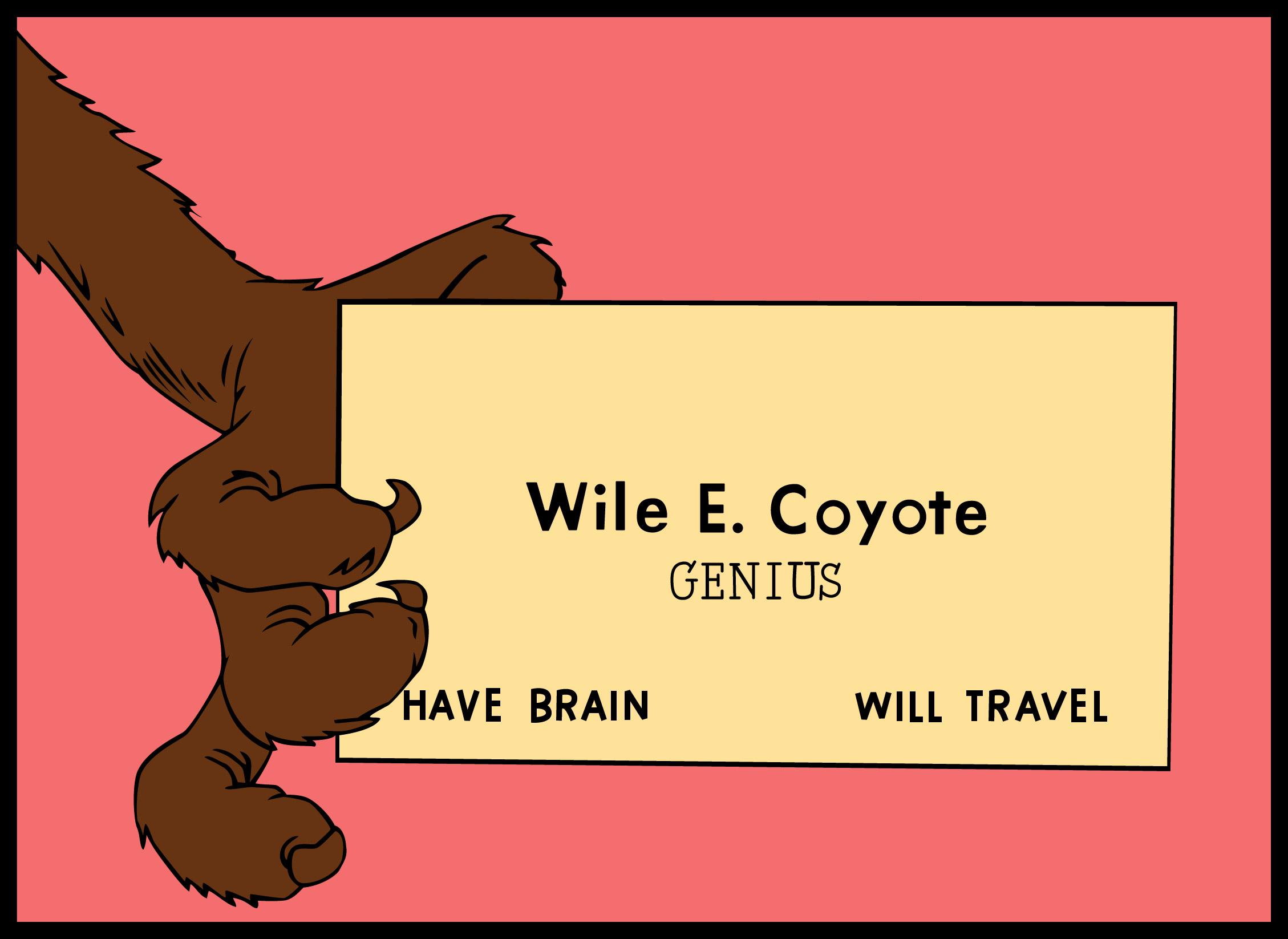
The Biggest Bullshit: David Lynch and the Cowboy
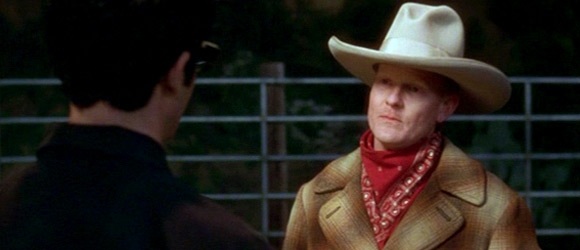
Well, there are many kinds of films. Most of them, nowadays, don’t demand much thinking. That makes me very, very upset. It makes me upset that they think the audiences have grown unused to thinking and that they only want things spelled out for them, in a platter. That’s bullshit, and a big one. People love to think. We are all detectives. We love to observe, we love to deduce. It is great to pay attention. We have a lot of fun this way. — David Lynch, on Mulholland Drive
You’re not thinking. You’re too busy being a smart-aleck to be thinking.—The Cowboy, Mulholland Drive
Suffering comes from the energy we perpetually expend in keeping up appearances of knowing, the constant knowing attitude we take toward life. Been there, done that, same old same old. It becomes the armor we clothe ourselves with—projecting this image that I know who I am, and why I’m here, and what I’m doing. In the postmodern world, this attitude has become institutionalized in sarcasm, ironic detachment, snarky jadedness, and (to use the Cowboy’s anachronistic expression) being a smart-aleck.
How true, the words of the Cowboy: We go through our lives taking a too-cool-for-school, smart-alecky attitude toward the givens of our lives, and as a result, fail to think and pay attention.
The Zen masters tried to get their pupils to stop knowing, to un-know, and they had different ways of doing it. The Soto school made the monks just sit, stop imagining they had anything more important to do or anyplace better to be. It’s much tougher than it sounds. It appealed (and still appeals) to students who naturally have calm, relaxed, patient minds. The Rinzai school, on the other hand, used story-puzzles, or koans, and appealed (and still appeals) to active intellects who naturally can’t resist interpreting and solving puzzles. Koans invite intellectual analysis, but at a certain point—weeks or months later—the intellect runs aground, and suddenly the monk finds himself or herself in a transfigured place.
“Rinzai” is how the Japanese pronounce the name of the 9th-Century Chinese master Lin-Chi. David Lynch says of his film Mulholland Drive that “We are all detectives. We love to observe, we love to deduce.” He understands people’s love of interpretation, of playing detective, and I would bet money he created Mulholland Drive as a deliberate koan. If meditated upon at sufficient length, it can take you to a place beyond interpretation. But we have to go through that effort of intellectual interpretation in order to awaken, to transcend. When we do that, we find ourselves not in a meaningless depressing world but in an enlarged, more immense, more spacious place that is full of possibility and importance and power.
I wrote in another post that Mulholland Drive specifically lures you to distinguish the “dream part” from the “real part” of the main character Diane’s (Naomi Watts’) story. Innumerable clues are there to indicate that the first two-thirds of the film, right up until the Cowboy’s “Hey pretty girl, time to wake up,” are meant to be seen as a textbook wish-fulfillment dream sequence that scrambles, rearranges, and transforms all the elements of Diane’s depressing “real-life” predicament—that she has hired a hit-man to kill her glamorous actress lover Camilla (the amnesic dark-haired “Rita” in the dream) after the humiliation and heartbreak of the latter’s rejection of her and announced engagement with a famous film director, Adam Kesher.
After a couple viewings of Mulholland Drive, this interpretation emerges pretty clearly and naturally. The film has thus been compared to The Wizard of Oz: The long dream core of the film consists of elements from the main character’s real life but jumbled and transformed according to dream logic, to create a fantasy that removes all the pains of the dreamer’s existence, erasing all of her guilt, and giving her all the things she wishes for. Textbook Freud.
Almost.
Once you’ve performed this “natural” interpretive procedure that the film invites, and followed it to its conclusion, you discover that you’ve been led into a trap: When you put the final piece in place, the film shows a message that was not visible before. This is the real genius of a film that is already genius on every more superficial level.
The key to the hidden message is the Cowboy.
The first time we (the audience) see the Cowboy is when he berates Adam Kesher for being a smart-aleck and for thinking he can have any woman he wants as the lead in the film he is making. He also says “You’ll see me once more if you do good, twice if you do bad.” Although it is addressed to the buffoonish Kesher, we likely take this promise as meant for “Betty,” the “real world” Diane, whose story this all really seems to be.
But … if we follow Diane’s “real” chronology as reconstructed in the aforementioned Wizard of Oz interpretation, this dream appearance is actually the second time Diane sees him—the first having been when he briefly walks through the room at the party where Adam and Camilla (dream Rita) announce their engagement. Diane’s dream has transformed this single fleeting “day residue” into one of two central psychopomps in the film (the other being the Club Silencio emcee), and her unconscious creates the dream of the Cowboy chastising and threatening Kesher that he’ll appear twice more if he does bad. This means Diane, the “real” subject of the movie, encounters the Cowboy only once more after this warning before she dies: When he appears at the end of her dream, in her doorway, and tells her it’s time to wake up.
We could interpret this as indicating that Diane has done well … done well, perhaps, by killing herself—after all, her life has become untenable, as she has had her former lover killed and the detectives know, and are knocking on her door. There is no other way out for her but to blow her brains out.
But let’s face it: If it isn’t Diane who’s being bad, then it is us, the viewers, who are being bad, since we do see the Cowboy two more times after his first appearance at the Corral.
Gulp. What did we do wrong? How are we being bad?
The Cowboy has already told us plainly: By being smart-alecks. Smart alecks don’t think they need to pay attention and think about what’s being said to them, because they think they already know, already have things figured out. But of all films, Mulholland Drive is designed as a big demonstration that no, we (we audience members, we human beings) do not have it figured out, and we are in fact very poor learners.
Lynch has said that one of his earliest films, a short called Alphabet, was about the “anxiety of learning.” This theme is clearly alive and well in Lynch’s late works too: Like the characters in his films, we are made to feel dumb by what he shows us. The Club Silencio emcee assures us that there’s no band, that it’s all a recording, and yet we are surprised when a trumpet player stops fingering his instrument and the music continues. And just minutes later, as Rebekah Del Rio sings “Crying,” we are just as amazed when she collapses on stage and her recorded voice continues to sing as we were when the trumpet player stopped playing.
So the Cowboy and the emcee at Club Silencio are both stand-ins for Lynch the Master, Lynch the teacher, who like his close namesake Lin-Chi famously just barked at or struck his pupils get them to see the light.
In Mulholland Drive, we are being shouted at by a teacher whose impatience is, despite his ferocity, infinitely compassionate. This is because his works have a real-world purpose. They are initiations: He is trying to transmit a bit of learning that has been important to him and that he really wants to share with us. We won’t get it as long as we are being smart-alecks, so he is in effect slapping us in the face to get us to stop that behavior long enough to see what he is talking about.
 I explained in my earlier post that what he’s trying to get us to see is that there’s no “real” and no “not real” in the film—they are fundamentally the same, just following different narrative rules, just shot in different styles, to lead us into the trap of picking them apart and distinguishing them. It’s like Lynch has taken us on this long, very enjoyable journey, getting us to play detectives (who are, as we speak, knocking loudly on the door), only to lead us to a back alley where we are shown Rene Magritte’s painting The Treason of Images—with a picture of a pipe on a school blackboard and the caption “This is not a pipe”: There’s no “dream” and no “reality” in Mulholland Drive—it’s a movie, stupid. All parts are equally fictional; nothing is more real than anything else. It’s all equally unreal. It’s all a recording.
If we need confirmation, only note the absence of a “real world” counterpart of the mysterious blue box. It is opened in the “dream” by the strange blue key. A mundane version of the blue key is conspicuous in depressed Diane’s apartment at the end, and in a flashback, it is shown to her by the hit man in Winky’s diner, who says she’ll find it “at the place I said” when he has finished his job of offing her lover Camilla (dream Rita). Diane asks, naively, “What does it open?” The hit man gets a quizzical look and just laughs and shrugs at her dumb literal-mindedness: The point is, the key is a message, not actually a functional key that opens anything. There’s no “real” box … just like there’s no band.
A teacher of Tibetan dream yoga, Tenzin Wangyal Rinpoche
I don’t know if Lynch has ever said it explicitly, but I suspect he would say it, so I’ll venture: Movies, like dreams, can seduce and delight us with their obvious and hidden meanings, but ultimately they should take us to a place beyond meaning. Have fun decoding them, but don’t think that’s enough, that it is just about proving your cleverness; learn to see through the movie to the Real. Lynch’s later movies invite us to interpret and find meaning, but they are koans—traps meant to take us to a higher place. Mulholland Drive is his most exquisitely designed trap.
***
Menopausal Mystics in Space
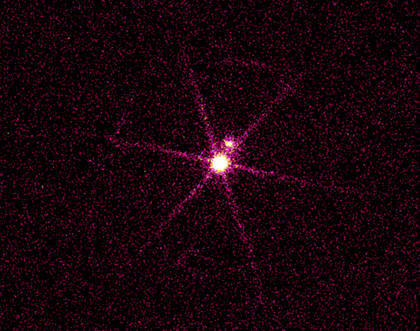
In my “Psychic Astronauts” post several months ago I thought I was being somewhat original by imagining a hypothetical cost-efficient scenario for our future exploration and colonization of space—one that made use of the interesting (at-this-point-unproven, admittedly highly controversial) notion of nonlocal mind. Specifically, I suggested that highly trained psychic explorers could remote view distant planets, visit them astrally (or, to be pedantically precise, etherically), telepathically manipulate organisms there across vast epochs of their evolutionary history (remembering that nonlocality applies to time as well as space), and then psychically inhabit or “possess” specially bred remote host vessels.
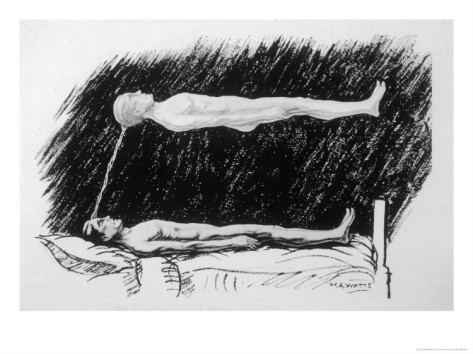 Faxing ourselves across space and time in this fashion sounds convoluted and crazy … but basically, if there is any truth to the claims of psychic researchers, remote viewers, and mystics since time immemorial, then there’s really nothing (other than our own present lack of development of those capacities) that would inherently prevent such a possibility. A project to train hundreds or thousands of psychic astronauts would be far less costly (and time consuming) than even a mere manned Mars mission, let alone a Star Trek-style space program.
I was certainly aware that this plan mashes together various ideas that have all appeared in science fiction—especially from the more open-minded, less slavishly scientistic era of pulp. H.P. Lovecraft, with his telepathic slumbering Old Ones, springs immediately to mind. (More recent scenarios of prehistoric alien visitation/intervention—such as those of Erich von Daniken, Zechariah Sitchin, and lately Ridley Scott—are more mundanely nuts-and-bolts, using actual spaceships, etc., in keeping with the dogmatic materialism of our day.) Until today, though, I had no idea of the true pedigree of the concept of psychic astronautics.
In a landmark archaeology of what could be called ‘ancient psychic astronaut theory’ on his blog The Secret Sun, Christopher Loring Knowles reveals that the Theosophical writings of Alice Bailey, especially her 1922 book Initiation: Human and Solar—supposedly channeling a Tibetan Ascended Master named “Djwal Khul”—describe precisely the scenario I sketched, albeit in reverse: the psychic colonization of Earth (via astral travel) by beings from the Sirius star system, who shaped ape-men into human beings to serve as receptacles for their consciousness.
Knowles is less interested in the crazy scenario than in its literary borrowing (too weak a word) by Lovecraft himself. In a point-by-point comparison, he shows that the parallels between Lovecraft’s “Call of Cthulhu” and Bailey’s channeled revelations about Earth’s distant past are so close as to be essentially plagiarism. Knowles suggests that the Darwinian Lovecraft originally wrote his dark novella in 1926 as a parody of the Theosophist’s occult ideas, but that he then carefully omitted all mention of Bailey’s book to his friends, not wanting to betray the unoriginality of his basic (and, in his hands, pretty damn cool) cosmic premise.
Though it doesn’t really dim my appreciation for Lovecraft, I love Knowles’ discovery. He notes that Theosophy, with its violet-hued astral planes and Ascended Masters in flowing gowns, was written mainly for an older, female audience. Terence McKenna (for whom the real ancient astronauts were the Stropharia cubensis mushroom) derisively referred to this demographic as “menopausal mystics.” Although there is a lot that is unoriginal, deeply questionable, and by modern standards rather un-awe-inspiring in the Theosophists’ cosmological visions, there is also much of value in their writings—particularly if you are open minded to the idea of siddhis, psychic abilities, and human potential in general. And they certainly supplied plenty of cool and original ideas to a generation of sci-fi writers who were less fetishizing of technology and more open-minded about the future (and past) of consciousness than many present-day writers.
Wouldn’t it be strange, and sort of wonderful, if mankind’s real future in space turned out to more closely resemble the channeled revelations of an early 20th Century menopausal mystic than the promethean hi-tech visions of Arthur C. Clarke and Stanley Kubrick, or Ridley Scott?

Lost and Found in Psychic Space: Airplanes, Aviators, and ESP

I’m fascinated by how aviation and missing planes are so often linked, in one way or another, to ESP phenomena. The ongoing, frustrating search for Malaysian Flight 370 seems like the perfect opportunity to write down some thoughts about this strange nexus.
There’s a long history of psychics being enlisted (or volunteering) to search for lost planes, for one thing. One of the best-known successes of the early operational remote viewing work at Stanford Research Institute (SRI) was the successful location of a lost Soviet spy plane in the African jungle using the talents of viewers Gary Langford and Rosemary Smith. The annals of remote viewing (as described in Jim Schnabel’s excellent history of the subject
So it is to be expected that today’s most accomplished remote viewers and other psychics are being recruited to search for the missing Malaysian jet. Uri Geller, quite naturally, says he has been asked by a “substantial figure” for help in the search. Geller is more famous for telekinetic and telepathic feats than for clairvoyance, but he made his fortune map-dowsing for mineral and oil deposits—a skill one would think is not too different from viewing lost objects at a distance. He has not pointed to an actual location for the presumably downed plane, that we know of. But according to The Anomalist, remote viewer extraordinaire Joe McMoneagle, one of the original Fort Meade team, has also been tasked in the search; he says he has “duly reported” his findings.
 When scientific or military professionalism and rigor are not involved, psychic attempts to locate missing aircraft are, as one can imagine, often not only unsuccessful but even tragically misleading. In his thorough and riveting account
The sad irony is that the first psychic consulted by parents of two of the lost boys, a dowser in a poor Montevideo neighborhood, turned out to have precisely pinpointed the location of the downed plane. Unfortunately the area he picked had already been overflown on early search flights and was, in any event, deemed too dangerous and remote for further searching. (Read’s book Alive contains more tantalizing ESP-related tidbits, including accurate premonitions of imminent rescue by some of the survivors; the more recent documentary Stranded
Then of course there’s Amelia Earhart.
When Earhart went missing in her Lockheed Electra in 1937, her husband George Palmer Putnam was inundated with mail from psychics and others who insisted they knew where Earhart’s plane had gone down, had had dreams of her, or had actually communicated with her psychically in the days and weeks following the disappearance. A 1940 article in Popular Aviation, which has been made available as a pdf on the Earhart Project website, is a great read and another fascinating account of the paranormal giving hope to those desperate to find their loved ones but also hopelessly muddying the waters of an investigation of a lost flight.
 The Popular Aviation article only details a few of the examples of the messages Putnam received, unfortunately, but the ones described are particularly interesting in light of the unfolding (but lately stalled due to legal problems) efforts of the The International Group for Historic Aircraft Recovery (TIGHAR) to piece together Earhart’s last days and recover remains of the Electra. From what one can glean from the 1940 article, psychic consensus seemed to be that she and her navigator Fred Noonan went down somewhere north of Howland Island—not south, in the direction of Nikumaroro atoll, where TIGHAR has found tantalizing evidence that the flyers actually ended up. However, people who corresponded with Putnam said that they knew she had survived the crash and was on an island or atoll, and provided scenes that correspond to the picture being assembled by TIGHAR—that the famed aviatrix and her companion survived, possibly for a few weeks, before perishing (probably from dehydration).
An interesting angle in this case is that Earhart herself was an accomplished psychic—although she publicly downplayed her talents in an era that was just as rationalistic and skeptical as ours. She had a particular knack for finding missing aircraft. As described by two newspaper columnists quoted by David K Bowman:
“Officials at first were inclined to laugh at Miss Earhart’s psychic messages. But her accuracy now has them mystified. When a United Airlines plane was lost just outside of Burbank, Calif. Dec. 27, Miss Earhart called the United Airlines office and told them to look on a hill near Saugus, a little town north of Burbank.
“There the wreckage was found.
“Again when the Western Air Express plane carrying Mr. and Mrs. Martin Johnson crashed Jan. 12, Miss Earhart reported the plane to be near Newhall, 15 miles north of Burbank, where it was found.
“In the earlier crash of the Western Air Express in Utah, Miss Earhart had a vision to the effect that the bodies of the dead had been robbed by a trapper. Two days later, a trapper near Salt Lake City reported finding the wreckage, but then suddenly disappeared without giving the location of the plane.”
There seems to be a link between a penchant for real-world flying and psychic aviation. For example, decades after his historic trans-Atlantic solo flight, Charles Lindbergh admitted in a memoir that during the 33-hour journey, during which he did not dare actually fall asleep, he experienced a hypnagogic, dissociative state in which he felt his body, soul, and spirit separate—what we might now call an out-of-body experience. During this experience, the flyer perceived and communicated with angelic beings accompanying him in his plane. The encounter left him with a lasting interest in the afterlife and immortality.
A more recent example is the popular author and aviator Richard Bach. After the CIA withdrew funding from the SRI project in the late 1970s (wanting to distance itself from questionable research in the aftermath of revelations about MK-ULTRA and other projects), Hal Puthoff and Russell Targ became increasingly creative in seeking support for their research at SRI. One person they sought out for possible help was Bach, whose bestseller Jonathan Livingston Seagull seemed (to Targ at least) like an account of an out-of-body experience—a phenomenon with strong continuity with remote viewing. On the hunch that Bach might be interested to participate in some psychic research himself and perhaps give some money to SRI, Targ and Puthoff invited Bach to California to take part in some experiments.
The writer proved quite talented. For example, in one out-bounder experiment described in Targ and Puthoff’s book Mind-Reach
The longest-distance psychic experiment ever conducted by an aviator, or anybody, is no-doubt that conducted by astronaut Dr. Edgar Mitchell aboard Apollo 14 in 1971. Like previous aviation pioneers, Mitchell had a profound mystical experience during his journey; but quite apart from this, he had a longstanding interest in ESP and, at four predetermined times during the mission, telepathically transmitted randomly selected Zener symbols (the type used in the classic Rhine experiments) to a small group of psychics back on Earth. He reported that there were 51 correct responses out of 200 total—slightly better than chance (there are 5 symbols in a Zener deck, so 40 correct responses would be predicted by chance). It is typical of the interesting but rather uninspiring positive results produced by classical psi research before the SRI era.
 The great precedent for Mitchell’s long-distance telepathy experiment, however, is far more inspiring. In 1938, a dashing, larger-than-life aviator and all-around hero explorer, Sir George Hubert Wilkins (left), volunteered on a dangerous mission to the arctic to search for a lost Russian plane and hopefully rescue the crew. Before he departed, he arranged to mentally send updates of his adventure at regular times each week to a New York writer with an interest in ESP named Harold M. Sherman. Sherman, for his part, recorded his impressions and had them notarized to prove that no cheating had transpired. Wilkins and Sherman documented the results in their classic book Thoughts Through Space
The records of Sherman’s and Wilkin’s experiment are remarkable, and resemble the sometimes astonishing accuracy of later CIA and military clairvoyants when real-world events and locales, rather than boring randomly generated cards, are involved. Reading the book through the lens of hindsight, it becomes clear—as it even became clear to the participants themselves when Sherman’s impressions were checked against Wilkins’ periodic bulletins—that “thoughts through space” did not accurately characterize the signal line through which Sherman received his information. Wilkins admitted he was often too busy, or simply forgot, to send his mental messages at the appointed times, but this did not prevent Sherman from obtaining detailed, usually accurate impressions of Wilkins’ activities and whereabouts.
In other words, Sherman was engaged precisely in remote viewing, not telepathy or (to use Upton Sinclair’s term) “mental radio.” Had it occurred to either of the experimenters to have Sherman psychically search for the missing Russian plane himself and thus serve as Wilkins’ guide rather than just his remote “receiver,” Wilkins’ mission may have been more successful than it was—but that would have required a paradigm shift in parapsychological thinking that was still over three decades off.
The experiment with Sherman is, to my knowledge, the first and last time Wilkins participated in an ESP experiment. Sherman, however, went on to write several interesting popular guides to developing ESP powers, not to mention numerous pulp sci-fi novels. In fact, he is a strangely absent figure in the nexus of psychic abilities, human potential, and sci-fi so densely chronicled by Jeffrey Kripal in his great book Mutants and Mystics.
In any case, there seems to be something fascinatingly archetypal about this nexus of aviation and ESP. Flying through air and space—and the extreme lengths to which one can get lost doing so—seem almost like a hieroglyph, in mundane 4-D reality, of how far one can travel and also get lost in the dimensionless space of consciousness and psychic abilities (or dis-abilities). Time will tell if and how this archetype plays out in the story of Flight 370. As The Anomalist notes, there may be little hope of anyone’s (even Geller’s or McMoneagle’s) ESP-derived insights having an impact on that search, given that there are bound to be hundreds or more intuitives, psychics, remote viewers, etc. giving their own conflicting reports. If I were one of the “authorities” involved, this is one reason I would be cautious following leads obtained from the paranormal information superhighway, however tantalizing they may be.
Postscript: Wilkins, The Nautilus, and SRI
Oddly enough, it is through an interesting mix of coincidence and distorted memory that Wilkins’ and Sherman’s Thoughts Through Space experiment may have had a decisive influence on the later research at SRI and the whole history of remote viewing.
According to Jim Schnabel, a 1960 report in the French magazine Science et Vie claimed that the nuclear submarine USS Nautilus had conducted a telepathy experiment on its historic voyage under the North Pole in 1958. Upon closer scrutiny, the claim proved to have been either fraudulent or based on fabricated information, but nevertheless it spurred anxiety on the part of the Soviets that the United States was developing psychic abilities for military application, and they began pouring money into paranormal research. It was this development, reported in Psychic Discoveries Behind the Iron Curtain in 1970, that in turn triggered anxiety in US intelligence and military circles that we may lose the psychic arms race if we didn’t fund such research ourselves. Hence SRI, and the subsequent developments at Ft Meade and elsewhere.
According to Schnabel, the source of the Science et Vie story that started the false rumor of US psychic research in the 1950s is unknown—it was either a hoax or may have been a deliberate disinformation ploy to get the Soviets to waste their money on paranormal woo. But I suspect the story could actually have arisen from a more innocent case of distorted recollection by someone involved in the magazine article or their sources, because it involves a fascinating, tangled knot of coincidences.
Several years before his 1938 arctic aviation expedition with its telepathy component, Wilkins had himself attempted to reach the North Pole underwater, in a decommissioned American submarine O-12 that he had leased from the Navy and rechristened, wait for it, The Nautilus. I think it would have been all too easy for someone to later conflate the various adventures of this dashing polar explorer (who sometimes engaged in telepathy experiments) with the news of the first actual polar crossing by a (this time nuclear) submarine, also named Nautilus, in 1958.
To make things more confusing, the nuclear Nautilus‘s first commander was named … Wilkinson.

Kafka and the UFO Gnosis
Rich Reynolds has a nice piece over on UFO Iconoclast comparing ufology to Samuel Beckett’s existentialist play Waiting for Godot. It’s a really apt comparison: The two main characters wait around for a person who is never going to come, and this waiting keeps them from becoming fully conscious and responsible for their lives.
A similar comparison I would make is to practically everything by Kafka. Ufology is murky, increasingly maddening, and you are perpetually unclear where you stand; you seem to be on the brink of figuring out some piece of the puzzle, and then you realize you are at the back of a line of aging people who have been standing in that same line their whole life, clutching essentially the same speculations in their dusty binders and briefcases, still awaiting confirmation from some authority that they have made progress though they have essentially gotten nowhere.
The whole idea of “disclosure,” particularly, reminds me of the central parable of The Trial. A man from the country comes before the Door of the Law, wanting access, but he is stopped by a doorkeeper who makes him wait, although not without accepting bribes “just so you don’t feel you’ve left anything untried.” The man waits his whole life, and finally, as he’s about to die, he finally asks the doorkeeper, “Why, if this is the Door of the Law, has no one else come seeking entry all this time?” To which the doorkeeper says, “Because this door was meant for you alone. I’m now going to shut it.” A brilliant light shines from deep within the edifice as the door is shut.
I see it as a sort of Gnostic lesson having to do with experience versus faith. The only important knowledge is experiential self-knowledge, and it can’t be thought of as coming from outside oneself, in the form of a religious or secular authority (such as the government, the UFOs themselves, or any other “subject presumed to know”—to borrow a term from psychoanalysis). You’ll get nowhere until you include the knower (you, the man from the country) in the known; the door, the light shining through it, and even the doorkeeper and especially the man himself are all part of the same picture.
I suspect that, when it comes to UFOs, what we need to know is already right in front of us, and the whole scene of “authorities keeping knowledge from us” is a bit of self-parody within a larger riddle (or koan) addressed to us, not the thing keeping us from cracking it.
We need to recognize ourselves as knowers. Dwelling on the idea that truth is “out there” is a way we overlook that explosive gnosis until it is too late.
____