The Nightshirt Sightings, Portents, Forebodings, Suspicions
“You see, Earth, it’s not that we’re lazy, it’s that we just don’t care.”
In his writings on contemporary culture, the philosopher Slavoj Zizek likes to invoke a concept borrowed from psychoanalysis, “the subject presumed to know.” Basically, we often project onto specific other people and institutions a sense that they hold the answers about us. It is derived from a patient’s inner conviction that his therapist really holds the answers about his own inner self but is putting off divulging it. Therapists make it easy to believe this by not saying what’s on their minds; the imagination readily projects “complete knowledge” onto them. Even if you know rationally that they don’t know, somewhere down deep we still believe it. People have always projected such a belief onto God, and now they do so with secular institutions. Paranoia about conspiracies, etc., reflects “the subject presumed to know” in a political or social context.
The UFO phenomenon is another clear manifestation of such a need to believe in a “subject presumed to know.” Somewhere I read a good description of therapists as manifesting “a freely and evenly hovering attention” to their patients, and I’d say this probably makes a perfect description of how people think of UFOs too. I am ready to admit that my last post feeds into such a belief: Basically, I’ve come around to thinking UFOs may well be real, that if so they are probably extraterrestrial, but that if that’s true, they are basically the advanced equivalent of our automated interplanetary probes–here to gather knowledge. But I think that’s all they are.
Because I think it is important to draw a distinction between “the subject presumed to know” and “the subject presumed to give a shit.” I think the interesting question raised by Mac Tonnies, about whether extraterrestrial visitors are actually sentient—to which my post was a kind of response—could be rephrased in these terms. Because I think that lurking within the concept of a “subject presumed to know” is the assumption that someone who knows, who has the answers, also on some level cares. Even their withholding of knowledge is somehow aimed at you, reflects some way in which it matters to them whether you know or not.
Popular culture surrounding UFOs tends to presume a level of giving a shit that, I argue, just isn’t present. If UFOs are real and they are extraterrestrial, they must be here to gather data and thus they certainly “know” a lot about us, but I suspect that they really don’t have any personal or collective investment–that they are essentially probes on automatic pilot, scouring the universe for data, originally created by now-ancient intelligences that are either dead or on some other plane of existence we just can’t fathom. I think it is possible, in other words, to reconcile the “small UFO” picture with a sublime vision more along the transhumanist lines advocated by George Dvorsky at the Sentient Developments blog. It only makes sense that some advanced civilizations with a thousand- or million-year jump on us would have at some point in their history been able and motivated to send out automated probes to every solar system in the galaxy.
The intelligent automation of UFOs is why they seem so autistic, so weirdly lacking in “sentience” in the way Tonnies describes. They are not planning some big contact event a la Close Encounters, any more than NASA’s Spirit rover has a plan for contacting Martian algae if it finds it—nor will they lift a single one of their four fingers to save us from destroying ourselves, if it comes to that. But they aren’t that motivated to hide themselves from us either. Such probes avoid being seen because it generally helps in gathering data, the way field biologists try to be unobtrusive when observing baboons, but in the end stealth is not an obsession.
So UFOs and their biomechanoid “pilots” are kind of like the Peter Gibbons character in Office Space: “You see, Bob, it’s not that I’m lazy, it’s that I just don’t care.”
“They” Are Not “Them”: A Hybrid View of the UFO Presence
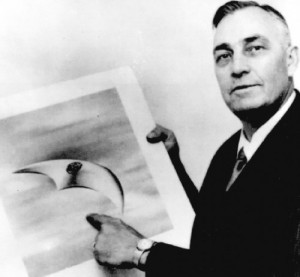 For many years I was skeptical of the UFO phenomenon. I was persuaded by SETI pioneers like Carl Sagan: It’s pretty certain that the universe is full of intelligent civilizations, but the vast interstellar distances and the vast timescales involved in traversing them made the notion of an alien presence in our skies seem (to me) silly. I tended to agree with science fiction writer Stanislaw Lem, particularly the view put forth in his great novel Fiasco. Civilizations will pass through a very brief “window” of maybe a couple centuries duration when they simultaneously have the technology required to communicate with other civilizations and still have an interest in doing so. After this, they will either have destroyed themselves/exhausted their resources or will have become “lotus eaters,” having solved all problems of material scarcity and retreated into virtual worlds of pure imagination, no longer caring who else is out there. Given the limitations on the speed of interstellar travel coupled with the fact that different civilizations’ histories will be wildly out of sync with each other, radio transmissions might be sent and received, but any actual two-way contact between different technological civilizations will be a tremendous statistical rarity despite the vast number of such civilizations that must arise.
I held to the view, in other words, that we would probably never make contact with an alien race, except perhaps by eventually finding its million-year-old ruins or fossils on some long-dead planet. The alternative, Star Trek-like universe teeming with roughly similarly advanced civilizations with similar agendas seems to defy both what I believed and, really, what I thought was most awe-inspiring: a sense of profound cosmic aloneness, despite infinite worlds and minds spread across unbridgeable distances.
As I’ve come to delve into the UFO stuff over recent months, however, I’m convinced that my old view requires revision. The evidence is overwhelming that Earth is being surveyed by alien craft. They are seen all the time, by perfectly sober and sane people. I saw them on two occasions, less than a month apart, this summer, and dutifully made my reports (obviously, this was a big factor in my revisiting the whole question). They are seen particularly often by pilots, astronauts, police, and people in the military. The latter four groups, for decades under explicit or tacit gag rules, are finally starting to talk openly about their experiences. It is becoming clear that the superpowers have gathered a lot of data that they have suppressed—for the very sensible reason that political control and social stability rest on governments seeming to be in control of their people’s security and destiny, an appearance that evidence of more advanced cultures in our airspace irrevocably punctures.
First of all, before I go any further: Is the UFO phenomenon a cultural construct? Of course it is. The same way “autism” is a cultural construct. Autism diagnoses have mushroomed in the past decades, not because more people are autistic but because more people are being recognized and classified that way. If it’s on our mental radar, it will influence how we make sense of the world, and it may be a productive filter. Whether or not there are actually more UFOs in our skies now than there were ten or twenty or fifty years ago, people are now primed to interpret anomalies in UFO terms and are less embarrassed to report seeing them. This certainly makes for more false positives, and more room for hoaxes, but it does not render the phenomenon “mythical” or part of our collective imagination.
And, lest I be seen as a conspiracy theorist or kook, my hunch is that, while they have probably gathered massive and conclusive evidence that UFOs are real and are extraterrestrial, the terrestrial powers that be may not actually know much more than the rest of us have been able to piece together. They probably have all the really excellent footage and photographs, perhaps physical evidence or even pieces of alien technology—too many people have admitted to such “secret rooms” and confiscations of military footage that it seems pointless to doubt. But whether our government has made any kind of actual “contact” is another question, and I’m quite dubious. I’m skeptical that the Pentagon or the Rand Corporation really know much more than the rest of us about the motives of alien civilizations to come and explore Earth.
To see why, I think we simply need to extrapolate from our own motives. If you had an interest in a less technologically advanced, perhaps even less-evolved civilization, what would you do to learn about it? And more fundamentally, why would you be interested in the first place?
For some reason, many people who write and speculate about UFOs and the motives of extraterrestrial visitors fail to do the obvious, which is put themselves in their shoes. And by “they” I mean the actual intelligences responsible for the visitations, not the visitors themselves. I’m surprised this distinction isn’t made more often, but if you extrapolate from our own space program, it seems pretty obvious that the UFO-nauts are not the “them” that sent them. If you draw this distinction, it makes the whole UFO thing seem much less farfetched and fanciful.
Let’s assume that, if nonhuman civilizations are able to manipulate space and gravity to the extent evidenced by their spacecraft, they have probably solved pretty much any other engineering problem we could imagine—which includes bioengineering and molecular engineering problems—and thus their reasons for sending spacecraft here have nothing to do with needing anything from us. They can clearly make whatever they need—mechanically, genetically, you name it. I surely think it is naïve to think they somehow covet our genetic diversity or want to breed with us. They are probably capable of more or less conjuring all their needs and wants via nanotechnology.
This is the good news, in a sense, because if they don’t need anything, there’s no motive for warfare or invasion. Call me naïve, but I suspect that Type-III (spacefaring) civilizations wouldn’t find themselves in much competition for the kinds of things wars are fought over, and thus “interstellar war” probably is mostly a matter of science fiction.
But another of the things “they” don’t want from us is cultural knowledge: What knowledge or insight could humans possibly have that an interstellar civilization, hundreds or thousands of years in advance of us [edit: Rick Philips makes the point that the difference factor would be millions or billions–he’s right.], could possibly use? We should assume that whatever our most brilliant ideas are—including the Four Noble Truths of Buddhism or The Golden Rule—they had those ideas, or equivalent ones, long before we ever did. I think that this answers one question that continues to vex many in the UFO community: Why haven’t they made contact? The answer is, there’s nothing for them to gain. The nice Close Encounters idea of interstellar “sharing” is the laughably simplistic vision of beings who are, to them, still tiny children with big dreams. (Think about it: Other than as passing or idle speculation, how many biologists actually want to or could “make contact” with the animals they study? What can baboons or even chimps tell us?)
So “they” are not here because they want anything from Earth (i.e., via colonialism, invasion, let alone “trade”), nor do they want to make contact with humanity in some tableau of cosmic love and harmony. The assumption we are left with is that they are here to gather data. And by the looks of it, they are probably systematically gathering vast, vast quantities, and may have been doing so for a long, long time.
Here is where we need to extrapolate from our own space program and realize who “they” are and why “they” doesn’t need to be the “they” that originally sent them to our solar system or our planet. Data collection by and large doesn’t require a vessel to be manned. When UFOs aren’t entirely automated (as I suspect most are), their occupants are surely not the beings actually responsible for the mission to Earth; they are surely something like clones, or biomechanoid creations, purpose-built or purpose-bred for space exploration. Perhaps their humanoid form is meant to facilitate data gathering with humans specifically. It is even quite possible that the visitors and their craft aren’t even technically interstellar but are manufactured from local materials right here in the solar system or on earth. All that really needs to travel between the stars is information—marching orders and instructions—the rest can theoretically be done locally with basic nanotech and matter-reorganizing factories.
Whatever the case, the data-gathering and data-recording abilities of such extraterrestrial probes are no doubt many orders of magnitude beyond what we can achieve, so we could assume such probes have archived virtually our entire culture. Which again helps explain why there’s no question of making contact. They would already know anything we would ever want to say to them.
The two motives for gathering data are science and security, and surely the UFO presence is related to both these aims. The science aim is obvious: An advanced civilization got to where they are via science and technology, and the motive to gather all information, whether or not it seems relevant, is an easy one to program into an automated probe—the “learn all that is knowable” imperative. This, we must assume, is a basic and not an applied science enterprise–a long-term investment with uncertain payoffs. Ours is one of possibly hundreds or thousands of planets whose goings-on are being surveyed and recorded by numerous civilizations in our own stellar neighborhood (writers who classify types of UFOs have surmised that there could be at least four distinct civilizations surveying earth right now), but if “they” don’t have needs in the sense we understand it, then it’s hard to imagine what application such data would ever have been envisioned.
The security aim is more in the background, but is probably of greater long-term significance. UFOs’ clear interest in our space program and weapons clues us into this: Here we are, on the brink of being a spacefaring race, if we play our cards right and don’t blow it. Depending on how things go, we might, in a few hundred or a thousand years, be some kind of minor player in the politics of our tiny corner of the galaxy (whatever “politics” looks like on an interstellar scale). Or, if the Lem-like vision holds, “they” won’t give a shit anymore (if they even did when they sent our their probes, which could have been aeons ago for all we know), but the descendents of their biomechanoid defensive superstructure will kick into high gear to protect their ability to lotus-eat in private once our exploratory probes reach their airspace. By that point, we might have stopped giving a shit too, but we will have done what any self-preserving civilization does to protect itself: putting a nice robot-and-clone buffer out there to protect our future interests. It is only at that down-the-road point of mutual political relevance that all this data would conceivably provide some alien race somewhere with some useful insight about us. If they are still around, that is.
So we shouldn’t assume that the “active interest” of the UFO-nauts is really all that active or interested. It should be seen as mechanical and automatic. This would explain what Mac Tonnies describes as our visitors’ “clumsy, oblique interactions with us” and why they seem simultaneously both “wildly sophisticated and limitlessly stupid.” Speaking of autism—isn’t that the sense one gets from these lights in the sky, or these “grays”? The Mars Spirit rover would seem pretty autistic too.
So the view I’ve come around to is a synthesis, or hybrid, of the standard UFOlogical and “sublime” visions of interstellar communication. I suspect that something like Lem’s vision is still closer to the truth—civilizations don’t overlap much, and interstellar politics is probably nonexistent or trivial over large distances—yet it is probably also the case that during their crucial “window,” civilizations do initiate massive and self-propogating data-gathering activities throughout their local stellar neighborhoods or even farther afield. No doubt these data-gathering abilities are matched by similarly astounding (and automated) defensive capabilities that would kick in if necessary.
“They” are not the ones who sent “them,” in other words, and we shouldn’t think we’re particularly hot shit because automated probes are watching us. The ones who sent them, the real extraterrestrials, are either dead and gone, have evolved into something completely different, or have bigger fish to fry. In a thousand years, when our first flying saucer reaches their solar system, if they are still alive and awake, they’ll rouse themselves from their meditation on the Three Noble Truths (take that, measly Earth Buddhists!) and download the voluminous data reports from Earth directly to their massive quantum brains. Only at that point will they raise their middle eyebrows in unison and go “Hmm, fascinating.”
Hirshhorn floor
So E and I went to the Hirshhorn this weekend. It’s my favorite DC gallery, but I hadn’t been in a few years. For some reason, I totally fell in love with the way the pinkish green floor looked in my iPhone camera. Then I got mesmerized by the marble floor on the upper level.
I think the other museum visitors thought I was autistic, or retarded, taking pictures of the floor.










Secrecy and Truth
Call me crazy, but I think that the age of open, free publication has done something to debase or weaken the domain of thought in the West. Where are the really powerful and amazing ideas?
I want to Prague in 1990 because I was in love with the idea of samizdat, of an underground culture where ideas had power and to share them was risky. Until just a few months before I arrived, there had been something really at stake in typing out a copy of a play by Havel on your manual typewriter, sharing a mimeographed essay by Heidegger with a few friends, or translating The Lord of the Rings into Czech. That world disappeared, of course, and no one I suppose thinks that’s too much of a bad thing. But where did the world of the spirit go?
The Internet has amplified a global tendency, created a world where ideas are everywhere, free for the taking. Don’t get me wrong: I’m not an enemy of this. I’m suspicious of claims to “intellectual property” and despise the ridiculous controls that corporations would put on digital writing, music, and art simply in the interest of profit. And obviously I don’t think states should censor their citizens or invade their privacy. But the price of the freedom we now “enjoy” has been a kind of homogenization of thought, a loss of the feeling that there is much at stake in any idea. Everyone blogs or twitters their every thought and feeling, but does anyone worry that fewer and fewer of these thoughts and feelings have the power to actually shock or amaze?
In the free capitalist countries there is the loss of the vital underground streams that nourished thoughtful persons living in Totalitarianism. The bookstores are full of books on any conceivable minute topic, yet do we really learn anything? We eat mental oatmeal, because there’s no meat anymore. I don’t think people remember what it is like to be shocked and amazed by ideas.
Am I wrong? Is this a childish proposition?
When I write for an audience, it always seems cheap, stupid. My best writing was ever done “for the drawer.” Secrets, I am starting to think, are worth keeping. Or at least, silence.
Here’s a proposal: That there is some intrinsic connection between secrecy and truth. If something is really true, at least philosophically, it has to be difficult or hazardous to divulge. Its audience should be limited, tightly controlled, or it should be made so obscure that only a select few will pierce its veil.
This was understood perfectly by writers of Alchemy’s golden age—the hermeticists in Prague during the reign of Rudolf II, for example: Devastating ideas are kept secret, shared with a very few.
In Denmark, No One Can Hear You Scream (or, Is Beowulf a Forgery?)
M.J. Harper and others at the lively and interesting site Applied-Epistemology.com are more than a little suspicious that Beowulf, and with it most if not all of the texts written in Anglo-Saxon (“Old English”), are forgeries created in the 16th century. It’s a really interesting argument. The Tudor period was a time of incredible cultural flowering and it was a time when the newly conscious nations of Europe, including England, were hungry for documents establishing their ancient heritage and, thus, legitimacy. Every nation wanted its Homer. The trade in forged religious relics had died with the Reformation, but a vigorous trade in national and literary relics took its place, and it is likely that the libraries of the gentry, whence the contents of the emptied-out monasteries landed, would also have been full of fabrications — many of them created by out-of-work former monks and scribes.
The Beowulf manuscript in the British Library is the sole source for the supposed Dark-Age story that everyone reads in English Lit, and its provenance can only be dated with any surety to right around 1700, the first time it actually is mentioned as part of the Cotton Library collection. The fire-damaged manuscript however bears the signature of a well-connected 16th-century Anglo-Saxonist Laurence Lowell, and is generally assumed to have passed through his hands sometime in the mid-1500s. If Lowell didn’t actually have a hand in creating the document, he may have acquired it via his employer, Sir William Cecil, when Lowell worked in his household tutoring Cecil’s ward, the young Edward de Vere (the later-famous Earl of Oxford, who in my view is the best candidate for the real authorship of Shakespeare’s plays).
Not unconnected to certain players in the story of the Beowulf forgery (if it is that) was the Anglican Archbishop of Armagh, also known as Bishop Ussher. He knew Cotton and used his library for his own research, and he also famously dated the creation of the world to 4004 BC, providing fuel for centuries of Creationist absurdity about the young age of the world. He’s the one who said that fossils were put in the rock to test our faith. It is really in the sphere of literature and history that we ought to be “creationists.” Documents may well be younger than they seem, essentially cultural fossils placed in the rock, made new to look old. More and more, despite initial misgivings, I am excited by the possibility that Beowulf is a far younger creation than anybody ever realized.
One of the reasons I always loved Beowulf and tried to get friends to actually read it is that aspects of it feel so weirdly modern. It has such wonderful aspects of sci-fi horror, for example: a resentful outcast monster lurking outside the light of the cheerful halls, preying on people at night, part of a race of creatures who have acid for blood. There’s a battle at the bottom of a lake. How cool is that? It doesn’t exactly feel like mythology, but like a novel. And then there’s the final dark episode with the dragon, which is totally classic. It’s a really dark and cool story, full of twists and turns and beautiful imagery of a misty, ancient Northern kingdom. This is why, despite Woody Allen’s quip that you should never take a class where they make you read Beowulf, readers are often drawn to the story and keep trying to make (invariably terrible) film versions of it.
The “acid for blood” thing has always stood out in my mind as particularly anachronistic for a story supposedly written down somewhere on either side of the year 1,000 and based on older oral tradition. Consider how vividly the poet describes it (this is from Seamus Heaney’s translation):
Meanwhile the sword
began to wilt into gory icicles
to slather and thaw. It was a wonderful thing,
the way it all melted as ice melts …
its blade had melted
and the scrollwork on it burned, so scalding was the blood
of the poisonous fiend who had perished there.
Alien, anyone? I’m not a chemist, but this sounds like a description of nitric or sulfuric acid’s affect on iron. Those acids were discovered by the Arab alchemist Geber in the 8th century, though were not industrially produced and widely used in Britain until, well, the 16th century. I have a hard time imagining a Dark-Age Anglo-Saxon scop (poet) or even a 10th or 11th century scribe writing such a description. What kind of experience would someone in Britain at that time have with highly corrosive acids? I don’t think a writer necessarily needs to have seen or heard about a thing to be able to imagine it, but this is an awfully singular image that strikes me as out of place before the Renaissance. (I’d welcome hearing a dissenting view on that from someone more acquainted with the history of chemistry/industry.)
Even more anachronistic, to my mind, is the covert theme of Beowulf, which is melancholia. I’ve always felt that the Beowulf-poet was not just some bard reciting one of the favorite legends of his people, but an original creator of a poetic work about the sickness of his own soul. The monster that terrorizes the previously cheerful hall of Heorot reads like a model of clinical depression: He is an exile, condemned to lurk beyond the reach of the light spilling from the hall of men, forced to listen in bitterness to the sound of their harps, the clink of cups, and their laughter. Unable to join them because of his original guilt (he is one of the “sons of Cain”), he lives instead with his mother at the bottom of a murky, monster-filled lake.
Anyone who has suffered depression would recognize these images and identify with Grendel’s alienation from the cheerful happy people, the stocky, manly Beowulves of this world (and perhaps would even identify with the Freudian/Hitchcockian theme of unresolved bitter and dependent feelings toward a similarly alienated mother). Grendel is a brilliant portrait of the bitter self-exile of the depressed person. By contrast, Beowulf himself is nothing more than a comic-book caricature, a frat guy cum uber-hero. In describing this contrast between the noble hall of the cheerful heroes and the alienation of the monster, the Beowulf poet was describing his own painful alienation from his fellows. The poem was a poetic expression of that melancholy loneliness.
People have always experienced introverted sadness, but just as “clinical depression” is a cultural construct of our age, melancholia was a cultural construct of the Renaissance. It was in the 15th Century that this kind of socially alienated introversion began to be romanticized and explored as an aspect of genius by writers and philosophers and playwrights. To my knowledge, you don’t get sensitive, sympathetic portrayals of melancholics before this period; and while Grendel is not exactly a sympathetic portrayal, there is definitely something sad about him and his life. It is hard not to feel his pain as he runs off, sans arm, to die at home with his mother. It is this sympathetic aspect of his character that makes Grendel seem so modern, and so inviting to modern reimagining by writers like John Gardner.
There is the whole notion that J.R.R. Tolkien, entranced by the mysteries of Beowulf and its ancient idiom, wrote The Lord of the Rings to flesh out the ancient mythological world of the Anglo Saxons and, in the process, create a uniquely English myth. What if he wasn’t original? What if, in fact, that’s what the original 16th-century writer of Beowulf was himself doing? I’m reminded of the quote by Hegel: The mysteries of the Egyptians were mysteries for the Egyptians themselves. There is an occult recursion in history, if you look carefully, and Tolkien’s relation to Beowulf seems like an example of that process.
Some of the pleasure of the “Beowulf-as-forgery” idea is admittedly simply the thrill of conspiracy, an unsolved mystery. (Finding out the truth will require carbon-dating the manuscript–perhaps after Harper and his friends gain sufficient legitimacy for their theory that the British Library could be persuaded to perform the necessary tests on this British national treasure.) But I also find that it actually adds to my pleasure in the text to read it through the lens of its being a possible product of the age of Shakespeare or Milton. I actually think it adds to the genius of the work to see its mysteries as being part of an atmosphere of pastness created imaginatively by a Renaissance writer, rather than simply a more or less faithful recording of a Dark Age legend.
Muzeum Alchymie v Kutne Hore
E. and I made a day trip to Kutna Hora to visit an Alchemy Museum run by an acquaintance from my Prague days, Michal Pober. A mutual friend, Dan Kenney, had introduced us back in ’97 in a quiet teahouse on a secluded street in Old Town. It had been one of those Prague conversations: a long meandering chat about everything esoteric — alchemy, the astrological layout of Prague, the Battle of White Mountain (and how Descartes may have been involved), Frances Yates, and myriad other subjects.
I don’t think Michal recognized me when he found E and I quietly poking among the dusty displays (which include lots of equipment, retorts, ovens, and giant bellows) in his museum 12 years later. But he gave us the grand tour of the building anyway, and talked at length about his discoveries regarding alchemical and related activities that once transpired in the region during its golden age (well, silver age — it had been a center of silver mining in the Middle Ages).
We went up to a tower room with still-surviving Renaissance frescoes and now outfitted to look like an oratory, and our guide discoursed on a number of subjects, including the alchemical activities of one of the house’s former owners, the illegal metallurgy that had gone on in the basement during the Middle Ages, and the hermetic interests of Casanova, who had lived out his last years as a librarian in the North Bohemian town of Duchcov. (Although obviously a follower of Casanova’s teachings, I had overlooked the occult side of the famous lover’s interests.)
Michal also told us of his discovery of the location of the original house where John Dee and Edward Kelly stayed when they first arrived in Prague. When our guide had himself first returned to Bohemia, he said, he repeatedly found himself eating fish soup at a particular table in a pub next to Bethlehem Chapel, a beautiful church in a still-mostly-quiet square just slightly off the main tourist drag in Prague’s Old Town (just up the street from the tea room where we had met for tea 12 years ago). Only later, he said, did study of old maps reveal that his favorite seat in this pub, U Betlemske Kaple, had been just adjacent to what (the maps revealed) was the no-longer-existing house of Emperor Rudolf II’s courtier Dr. Hageck. It was here, “at Bethlem,” that Dee and Kelly stayed temporarily; a previous occupant of their room had been an “A –” who had covered the walls with alchemical symbols and a Latin inscription.
Now, curiously, Michal then asked if I knew what “A–” meant. It was an uncanny moment. I had been asked the same question about “the meaning of A–“, very significantly, in an alchemical dream almost exactly a decade ago. In that dream, I had been of the opinion, possibly mistaken, that it stood for “Androgyne”; this time, when I hesitated to answer, Michal explained: “Adept.”
At the point I had been asked about “A–” in my dreams, I had been studying hermetic philosophy quite actively, to the detriment of my “official” anthropological studies. But I had largely ignored Dee’s writings (other than the Monas Hieroglyphica), because as “angel magic” it struck me as less relevant. Now I really wish I had read A True and Faithful Relation sooner. Needless to say, I quickly obtained a copy on my return home — both Casaubon’s version and the recent abridgement by Edward Fenton.
Dee records that the “student, or A– skilfull of the holy stone” who had occupied the chamber, Simon Baccalaureus Pragensis, had written on the walls this message (in Latin):
“This art is precious, transient, delicate and rare. Our learning is a boy’s game, and the toil of women. All you sons of this art, understand that none may reap the fruits of our elixir except by the introduction of the elemental stone, and if he seeks another path he will never find the way nor attain the goal.”
Cosmic WTF
A new article in Sky & Telescope magazine reports on a recent discovery of a highly anomalous “optical transient” detected by the Hubble telescope in the constellation Bootes. The object, in the location of no known star or galaxy, appeared and brightened to the 21st magnitude over a span of about 100 days, and then disappeared over the next 100 days. It didn’t behave like any known supernova (which is what the sky survey was looking for), and spectrographic analysis doesn’t match any known type of object. Because they don’t know what the object is, the astronomers can’t even say how distant it is — only that it must be at least 130 light years away because no parallax was observed (which can be used to pinpoint nearer stars). They don’t know if it is (well, was) inside our galaxy or in another galaxy.
The original article is way too technical for me to follow. But I gather that hydrogen is missing from the object’s absorption spectrum. This, according to Robert Zubrin (Entering Space), would be one of the telltale indications of starship exhaust, which could potentially be detectable by our telescopes over very long distances. Could the “optical transient” have been a distant interstellar spacecraft (perhaps propelled by antimatter) accelerating or decelerating? (A number of other exotic suggestions have already been offered by S&T readers.)
If anyone reading this understands spectrography, please enlighten me!
Politely ignoring linguistic primitivity
M.J. Harper (The Secret History of the English Language
But that’s just political correctness—or, I suppose, good manners. The professional insistence on not calling one extant form a descendent of another extant form is really just a matter of politeness. It would offend fragile human sensibilities to say we evolved from chimps—I mean, just look at them!—so we say instead “from a common ancestor.” And the chimps feel better too, because yeah, they haven’t been just slacking off either; they’re nothing like those boobs of the Pliocene. When you assume evolution moves at the same pace for everyone, everyone saves face; everyone keeps up appearances that “we’ve all been evolving all this time, everyone evolves the same amount, nobody’s calling anyone ‘primitive.’”
But just because a word or a concept can be used derogatorily doesn’t mean it’s not descriptive. Let’s put aside political correctness (and, heck, manners) just a moment. Evolutionary biologists know that some species and some adaptations are more primitive than others. Evolution does not occur at a constant rate for all species, and there is no reason one living species couldn’t have branched off another living species that, for whatever reason, did not change at all in the interim. When speciation occurs due to geographical separation, for example, there is nothing in principle mandating that one branch could become radically different due to rapidly changing local selection pressures while the other branch could be relatively unchanged after a given period of time due to selection pressures that remained constant in its particular neck of the woods. Speciation is not Newtonian: It doesn’t demand an “equal and opposite reaction” on the part of both bifurcating species, esp. if geography is the reason for the split.
Cockroaches and coelacanths and sharks are called “living fossils” because they’ve stayed the same while the world around them has changed more rapidly. It’s not a sign of being old and stuffy; it’s a sign of a good adaptation, one that nature hasn’t found a way to improve upon in its particular niche. Harper is suggesting that this is what happened with English—or, English as she was spake in Neolithic Britain. Some sort of English (he argues) was spoken in the dim mists of prehistory by a group that settled throughout Europe. On the Continent, affected by different historical and demographic pressures, this ur-English bifurcated into two broad linguistic streams: German and French, which in turn evolved into various local forms. But on the island of Britain, it changed much more slowly. (I gather that place-name archaeology and genetics are starting to corroborate this idea, at least somewhat, although linguists will have nothing to do with it.)
In other words, following Harper’s line of thinking, saying German and French didn’t evolve from Modern English is trivially true only in the sense that they didn’t evolve from the English spoken in our day, but the English spoken thousands of years ago. Yet, if that ancient English was so close to Modern English to be regarded as, essentially, the same language, then why not say German and French evolved from English?
Well, I already answered this question: It’s just politeness that dictates you don’t say that. The Germans and French must be allowed to save face, here. No doubt, should Harper’s paradigm gain more acceptance, manners will dictate that we name the English spoken in pre-Roman times something else, like “proto-English” or whatever (since “Old English” is already misappropriated by the Anglo-Saxonists), and it will be called a “common ancestor” to modern English and the bitter tongues of the Continent.
The Secret History of the English Language
Reckoning the origins of words is a politically significant exercise, and etymologies, wherever and whenever they are from, are notoriously full of shit. They always reflect someone’s political vested interests or fantasies of “who was here first.” Yet somehow the old dons who gave us our etymological bible, the OED, have always remained above suspicion. These are tweedy respectable old guys who don’t go in for politics or fantasy (well, ahem, besides J.R.R.). And good god, what a huge dictionary it is, with such teeny tiny little words. It must all be true.
If a mysterious, snarky personage named M.J. Harper (about whom all is known is that he “lives in London”) has anything to say about it, the last hundred-odd years of English etymology, philology, archaeology, and history are due to be swept aside, and with it the hoary origin myth of the English language that we learned in school. The Secret History of the English Language
At first, Harper’s “applied epistemology” sounds like the puffed-up ‘methodology’ of a manic-depressive paranoid who either never finished his PhD or, despite finishing it, works in a used bookstore, and either way has nursed a grudge against his professors for twenty or thirty years. As a science editor I get sent a lot of self-published books from the pseudo-science and pseudo-academic fringe — heck, I consider myself part of that fringe — so I know the signs of this mentality. But I don’t think Harper can be reduced to that rubric. He appears to be a smart guy, and rigorous enough in his thinking to be taken seriously, despite his flip tone. And a bit of snooping around on the internet reveals that ideas that harmonize well with his theory are emerging from archaeology (Win Scutt) and genetic studies (Oppenheimer) as well. I don’t know, but a bona fide paradigm shift might be in the offing.
Basically, Harper’s idea is this: English did not evolve out of Anglo-Saxon, as we were all taught. There’s no evidence this happened, and moreover, such an account of the origins of a major language runs counter to everything we know about language everywhere else in the world: It’s a remarkably inert thing. It doesn’t evolve quickly, and people don’t just throw an old one out to adopt a new one. History also offers no real evidence for the cherished English creation myth. There’s no evidence for the “Celtic” language originally spoken in the areas that were taken over by the Anglo Saxons, for example.
Harper’s method boils down simply to the application of Occam’s Razor: The simplest explanation is probably correct. It is far more likely that what the natives were speaking when the Normans arrived, what they were speaking when Hengest and Horsa arrived, and what they were speaking when the Romans arrived, and what they were probably speaking even back when Stonehenge was built, was pretty much what they speak now. Middle English is not an intermediate form between Modern English and Anglo-Saxon (mis-named “Old English”); it’s basically Modern English spelled differently, simply because it reflects the awkward beginnings of English as a written language. Anglo-Saxon, on the other hand, was a related but foreign language spoken by the foreign conquerors, which duped everyone into thinking it was the original form of English only because it happened to be written down before English ever was (though not very often or frequently—Harper even suggests Beowulf is a forgery, although I don’t think such a detail is necessary to his argument). Likewise, the Normans didn’t infuse English with its “Latinate” component. That was part of English all along.
Migrations and incursions and sweepings-away-of-whole-peoples are far more stimulating to the mind than glacial inertia. That’s why myths are full of such upheavals. Thus, how much more exciting to say that the word “beef” was imposed by our Norman conquerors after 1066 than to say that the word “beef” evolved from … well, “beef.” According to Occam’s Razor as, um, wielded by Harper, the Anglo-Saxons and Normans, like the Romans before them, didn’t do anything to the language. In both cases the “doing to” had been done long, long earlier, much more slowly, and in the opposite direction. Because English, he suggests, is really the mother of the tongues that have until now been thought to be its ancestors.
As I understand Harper’s parsimonious schema, something like English was originally spoken all over the continent, giving rise to German and the Scandinavian languages in the north as well as French and the Latinate languages to the south. (I’m ignoring for simplicity the Celtic languages that held fast all up the Atlantic seaboard, including Wales, Western Ireland, and Western Scotland.) So despite what you were told in school, “beef” was original and boeuf descended from it. Which has gotta hurt, if you’re French. The consolation for the French is that theirs is the mother of the Latinate tongues, including Latin (which originated as an artificial, written shorthand—the reason those inscriptions are so succinct). The fact that English only survived in its more or less original form on an Island makes a lot of sense: Events unfolding on the continent accelerated linguistic change. Islands often preserve older biological species even after their continental counterparts have gone extinct or been replaced, so why not languages?
Harper doesn’t point to much data, unfortunately; he’s more interested in uncovering gaps and anomalies and showing how people have imposed their own, convoluted stories to cover them up or obscure them. And the Occam’s Razor explanation sounds boring, at least at first: It requires no invasions, conquests, genocides, or any of the other colorful affairs of history. But for those whose academic reputations aren’t at stake, the implications of Harper’s theory would indeed be pretty amazing. How cool to think, for example, that English could be the oldest Indo-European language in Western Europe—a direct link to the mind and culture of, for example, the people who built Stonehenge?
Evolution of the Eye
Wikipedia has a terrific, thorough and readable explanation of the evolution of the eye from earlier structures (directional photodetectors found in simple, even single-celled organisms). It has nice diagrams and pictures of the intermediate forms leading to this astonishing structure. Next time you have lunch with a Creationist or “intelligent design” proponent–who love to flog the eye as defense of their case–do your homework first.