The Nightshirt Sightings, Portents, Forebodings, Suspicions
The Singularity (Thoughts on Bifurcation, pt. 1)
“Who wants to live forever?” – Queen
Transhumanists plan for the coming Singularity, the threshold of transcendence of biological mortality and of flesh-enslaved consciousness—i.e., posthumanity. Ray Kurzweil for example clasps his hands together and squeals that the first person to be immortal is already alive, and that we can right now (through diet and exercise) try to “live long enough to live forever.”
To be sure, defeating death, escaping the infirmities of the flesh, sounds wonderful. Who doesn’t want to live forever? The trouble is, the advantages conferred by technology are never available to everyone, or even most people, and certainly not everyone all at once. Kurzweil et al.’s death-free posthuman future will not touch all of us at the same speed, although the vague hope is that somehow it will arrive to everyone eventually—trickle-down immortality.
Is there a realistic business model for delivering immortality to the masses?
Somehow space tourism symbolizes, to me, what the post-Singularity world will be like, and why I’m not as excited by it. I’m able to overlook the terrestrial ease and pleasures of the super-rich and not spend every waking moment dwelling on the fact that I’ll never remotely be able to afford a yacht or a castle, but somehow space tourism is in another category. It is a visible symbol of, not merely a luxury, but an actual transcendence that it is simply beyond the reach of all but a very privileged few. And somehow it galls me to my core. I have a hard time accepting that the hyper-privileged can travel into space if they want, and I’ll (probably) never be able to.
What, then, about immortality? That’s way beyond even a trip to the International Space Station.
Since the beginnings of civilization some 10,000 years ago, the rift between the haves and the have-nots has widened and widened. Is there any reason to think the Singularity or any social/technological horizon like that would reverse the trend? Somehow I don’t expect that the first cohort of the Uploaded Super Rich will be eager to share their privilege or even let us know of it. How will the rest of us react to news that Bill Gates uploaded his consciousness to a computer housed in an expensive artificial body? Will we be celebrating with him? Probably not. He’ll have to do it in secret … or retreat to his lunar estate.
The classic sci-fi dystopia is humanity enslaved by our machines. I imagine a slightly different future, in which humanity is enslaved—or not enslaved, just kept perpetually in the workaday status quo—by the Uploaded Super Rich, jealously protecting their immortality. The USRs will retreat to their space stations, finally to the asteroid belt or farther, each one a demigod, each one a Howard Hughes, each one descending into paranoia and finally a lonely machine madness, while the rest of us keep going to work and now and then upgrading to the latest iPhone.
Childhood’s End … and the End of Camping, Too
To me, the most haunting image in Richard Dolan and Bryce Zabel’s new book A.D. After Disclosure is this paragraph (p. 86):
There is … a story offered by a high-level intelligence official about a UFO briefing President Carter received in June 1977. It was unknown to the source what specifics were discussed, only that when the President was seen in his office, he was sobbing, with his head in his hands, nearly on his desk. It was clear that the President was deeply upset.
The authors of A.D. offer a very persuasive prediction for how humans will react to the knowledge of “Others” visiting or living on our planet. But while they comprehensively summarize the various other possibilities, they appear, along with almost everyone who has ever given an interpretation of the data, to basically favor the extraterrestrial hypothesis — that those Others come from space (or if not space, then somewhere else similarly exotic — other dimensions, the future, etc.). But my question in this post is this: Would revelation of extraterrestrials on earth be enough to bring a president to tears?
I think the reaction to a disclosure that, instead, the Others were actually from right here on earth — that is, that they were cryptoterrestrial (to use Mac Tonnies’
Our natural anxiety at the prospect of visitation by extraterrestrials (anxiety over their advanced technology, their uncertain motives, our newfound insignificance in the cosmos, etc.) would in an A.D. situation be tempered, as Dolan and Zabel note, by a great deal of awe. There would be so much to learn, so many ways in which our minds and our lives would be forced to grow and change, so much redefinition of our place in the universe. Awe may even ultimately triumph over anxiety. This would certainly be the case if, as many predict, Disclosure came with a reassurance that such beings are here to observe us, perhaps even help us, and basically mean no harm. For this reason, whatever the conflicted feelings they’d arouse in us, beings from other planets would probably not seem like monsters. Who wouldn’t want to meet one, touch one, talk to one? I know that it would be the greatest moment in my life to stand in front of an extraterrestrial being face to face.
Even if they turned out to be hostile, requiring a mobilization of our defenses, martial law, etc., we would react to them like foes — opponents — not as horrors. We describe Nazis as “monsters,” but they were fathomable, we met them on safely remote battlefields, they were technological and malevolent mainly in a political and human rights sense. Americans at home or in other places than Europe didn’t fear encountering them on lonely roads or when out camping; we didn’t have nightmares about them coming into our homes and kidnapping us. They were not horrifying archetypes of the collective unconscious.
But think how it would be different if it were to be revealed that the “aliens” had always been here, were from right here on earth, and shared a common ancestor with us. The reaction would be totally different, I think. Would there be any awe to counterbalance our anxieties?
As intellectually fascinating as the prospect of cryptoterrestrials is, I think standing face to face with a coldly emotionless, pale, and highly intelligent secretive dweller of our planet would scare me shitless and not make me feel anything in the way of awe. To the contrary: Every primal human terror, every nightmare, every notion of the monsters under our beds or visiting our homes at night, would be confirmed as real, not just as figments of our imaginations. (In a previous post I discuss how intrinsically repulsive or frightening cryptohominids would be, simply on the basis of their close-but-not-quite-human physical form.)
Think about it for a second. If there is a race of stealthy “people” who for millennia have visited and even abducted people — who are perhaps responsible not only for animal mutilations but for disturbingly similar human mutilation cases and even the 30,000 unexplained disappearances of humans every year, it would give new reality to the most horrifying of archetypes. How similar is the Nosferatu archetype for instance — pale, gaunt, bald, long fingers, as he appears in the window gazing in on us with animal desire — to a stereotypical “gray”? And what is the animal mutilation typically associated with UFOs but seemingly vampiric behavior? No one would ever go camping again.
Compounding the horror, revelation that the Others were cryptoterrestrial would make the world bleaker — depressingly so. For one thing, it would destroy the ET myth, which probably hovers in the back of our minds as a reassuring possibility more than most people would care to admit. What are extraterrestrials, at least in our pre-Contact archetypal pantheon, but a kind of hope for a world and a life that’s bigger? Some even see them as angels. Revelation of a cryptoterrestrial origin for UFOs would rob us of that Great Hope and make us feel very, very alone indeed — alone as Ripley at the end of the movie Alien. Alone in the sea of space, sharing our cramped planet with a smarter, colder distant relative that is not only mildly, thus more disturbingly, other, but also historically somewhat malevolent. In space, no one can hear you scream.
So I can’t help but feel that the cryptoterrestrial possibility would result in a very different post-disclosure world than the socially and intellectually engaged, technologically and maybe militarily mobilized world Dolan and Zabel envision. There would be zero desire for “contact,” except perhaps by a narrow subsection of scientists. Many or most global villagers would take to the streets and to the air and to the caves and to the water and to the Internet, pitchforks raised. There would be not only “social unrest” but probably an ultimately uncontainable worldwide frenzy to “destroy all monsters.” (Moreover, any slighter physical resemblance to particular human races — e.g., Asians? — would perhaps rekindle the kinds of racism it has taken a century, and the global village, to begin to erode. Humans would turn against humans, not just against the real Others.) If you think the “war on terror” is distressingly open-ended, imagine a “war on horror.”
Just in this century we possess weapons that could really pose a threat to a hidden species. Underground bases may seem safe, but we now have bunker-busting missiles — even nuclear tunneling machines. Some angry country — even ours, if compelled to by a terrified voting public — could certainly do a lot of harm to a secretive subterranean or underwater civilization with just a few well-placed nukes or deadly biological agents. So what we say of bears would probably be just as true of cryptoterrestrials: They are as scared of us as we are of them. Shitless, would be my guess.
Tonnies made a good case that this possibility — that the Others are a vulnerable, scared, earthbound species — makes the best, indeed most parsimonious (albeit counterintuitive) sense of the theatricality of UFOs and their pilots. All the bright lights — what is that but an attention-getter? They want us to see them but also be awed by their technology, so they dazzle us, orchestrate displays of their apparent military superiority. By their unpredictable, bizarre behavior they reinforce the idea of their literal otherworldiness. In abductions, as in the famous Betty and Barney hill case, they unveil almost comical star maps and point to them. The alien seductress who essentially “raped” Antonio Villas Boas afterwards pointed to her belly and then to the sky.
The entire UFO phenomenon could really be a big PR disinformation effort to preserve their safety. As much as we hate and fight the monumental disinformation about UFOs our government has engaged in for the last 60 years, the prospect of the genocide of a vulnerable terrestrial race would make that policy seem, in hindsight, not only sensible but necessary. I wouldn’t blame the secret-keepers so much if it were the case. And as Disclosure comes to seem more and more inevitable, such a reality would sort of justify the imperative to foster the extraterrestrial hypothesis at all costs — to the extent of not allowing any scientific investigation of the beings that could reveal a common genetic code. Such a policy of deception will have been, in this scenario, as much for the Others’ protection as for ours.
There are lots of stories about underground alien bases — in the Pacific Northwest, in the American Southwest, and in Asia — where superpowers’ militaries cooperate with an alien presence. Were it somehow indeed the case that such bases are more than bases but actually access points to deeply hidden enclaves of native beings, there would be no way for world powers to ever divulge that. They simply couldn’t. They would, like the cryptoterrestrials themselves, have to keep pointing to the skies in the desperate hope that it would never occur to us that their home was right here, perhaps right under our feet (and by extension, right under our beds).
Fortunately or unfortunately, it has occurred to more and more of us. Hopefully it’s just not the case.
Dolan and Zabel write that Disclosure is both impossible and inevitable. If the Others turn out to have lived here all along, I believe that Disclosure will never, ever be truthful. Otherwise there really could be a war, of the intraplanetary variety. Given their technological ability (if not strength in numbers), they would surely retaliate against any human threat in a huge way. They would be fighting for their lives, because they’d have no other home to flee to.
“After Disclosure”
 The very next day after I wrote the previous post — about how we should just assume the reality and significance of the UFO phenomenon and proceed from there — what should arrive on my doorstep in an Amazon box but the new book A.D. After Disclosure
This is a thrilling, landmark book, the first in what will inevitably be the next, post-Fortean phase of ufology — i.e. when it becomes a subject of legitimate study within the mainstream. The implications of disclosure/contact are staggering, and the authors map out, with great intelligence and forethought, what the world will look like after it happens — very likely in our lifetimes. It will be the biggest story in history, and its repercussions will be felt in every aspect of our society.
A.D.: After Disclosure is the capper in what has been a fantastic year in ufology, with some of the best, most serious books ever written on the subject: Leslie Kean’s UFOs: Generals, Pilots and Government Officials Go On the Record


My Amazon review of A.D. is reprinted on the authors’ Web site.
The Good Kind of Ass Out of You and Me: Toward a Post-Fortean Ufology
Like looking at the sun, you can sometimes get blinded by a topic of you stare right at it.
For six decades, those interested in paranormal and Fortean phenomena have been blinded by the subject of UFOs. It’s not that there’s too little information. It’s that there’s too much—too much conflicting evidence and not enough context for any of it. Too many sightings, too many photographs, too many different kinds of experiences, too many different kinds of objects, too many stories, too many witnesses, too many hoaxes, too many theories, too many preconceptions, and too many “investigators” with too many agendas. It’s also a subject that seemingly knows no boundaries. A recent issue of MUFON Journal had a cover story relating UFOs to 2012 prophecies—what an embarrassment, what bullshit (I’m not renewing my membership). Ufology is a chaotic mess, and it’s not surprising that the outside world has taken little notice of the field or the subject matter.
Like when studying the sun, the best way to study an unviewable topic is sometimes to block it out (temporarily) in order to see how it affects things around it. It is just in the past decade that a few investigators have adopted this more cautious approach—blocking out evidence for and theories about UFOs to focus instead on the history of the “UFO phenomenon” and its cultural, social, and political context. Mostly it has been by outsiders to the field, approaching the subject as academics or journalists. And the effect has been incredibly clarifying—and not, as one might expect, undermining. Quite the contrary. The entrance of historians and journalists into the field is more than anything else the reason the topic is making its first steps out of the Fortean ghetto and into the mainstream.
Richard Dolan, for example, is not a “ufologist” in the standard sense, but a historian who has documented the intense interest of the U.S. government, military, and intelligence community in the UFO phenomenon ever since the late 40s. He has also documented the interest of the interested in appearing disinterested. In the early 1950s the government exerted pressure on the media to not take “flying saucers” seriously. The effects of that are still seen: Any news report related to a UFO sighting is accompanied by X-Files music and jokes. And the powers that be have shown nothing but dishonesty when discussing the subject. Dolan shows that the two famous “investigations” of the phenomenon—the Air Force’s Project Blue Book and the University of Colorado Condon Committee—were both essentially public relations exercises; their mandate was to discredit the subject while making the government and military appear open-minded to the public’s concern over it. Only a small percent of the reports collected by either group were actually investigated; and Condon was chosen to lead the CU team because he had already expressed his unshakeable belief in the nonexistence of the phenomenon. These “studies” were farces, in other words.
Unclassified and classified documents obtained from the U.S. government through the Freedom of Information Act, and the files of many other world governments that have recently made public their UFO case records, massively document the existence of unexplained, solid, gravity-defying, astonishingly fast, and intelligently controlled aircraft (note: not necessarily spacecraft). Since the end of World War II there have been hundreds of thousands of reports of sightings from every country in the world, often by reliable witnesses including military personnel, police, commercial airline pilots, and astronauts. Many, many sightings have been independently corroborated by multiple witnesses (or even large groups of witnesses, as in Belgium in 1989-90 or the 1997 Arizona Lights incident) and are very often verified by radar. In a few famous instances, for instance in Washington, DC, in 1952, in Iran in 1976, and the 1989-90 Belgian case, such objects have been pursued by fighter planes, easily outmaneuvering them before disappearing at impossible speeds. In a few cases such as Malmstrom AFB in 1967, UFOs have appeared over missile launch facilities and somehow deactivated the missile launch systems.
The “caliber” of witnesses to the UFO phenomenon has increased in recent years. Serious documentary filmmakers and journalists like James Fox and Leslie Kean have worked to present the subject in a serious and sober, not sensationalistic, light, and this has certainly been an encouragement for people with a lot at stake, and a lot of respectability, to come forward and talk about what they know. These include pilots, who for decades have been forbidden from talking about their sightings, military personnel (including fighter pilots and soldiers at military bases), and astronauts. Personnel involved in the Malmstrom AFB incident recently spoke at the National Press Club about the event. Dr. Edgar Mitchell, the sixth man to walk on the moon, has openly stated that he knows the UFO phenomenon is real and that the government is wrongly concealing what it knows; Gordon Cooper, one of the original Mercury astronauts, has described his involvement in filming the actual landing of a flying saucer at a military base in the 1950s and then the confiscation of the film by military authorities (see Fox’s documentary, I Know What I Saw
As independent thinkers and skeptics, we should not be swayed by authorities. We should make up our own minds. Yet, it would be stupid not to look to those who know more than us for some guidance. The fact that UFOs have quietly been taken very, very seriously by people in authority since the 1940s, along with the fact that some of those people (who have a lot to lose and nothing to gain) are now publicly attesting their reality, is just one among many very good reasons we should not smirk at it anymore, or whistle the X-Files theme.
We are told assuming is bad, but it seems we should stop rehearsing the evidence and assume the reality of the UFO phenomenon and proceed from there. Because no matter how you slice it, if UFOs are real — and I really think we can now drop the “if” — then they are unquestionably the biggest story of our time.
If they represent the presence of extraterrestrials, it would be monumental, having profound implications for our conception of ourselves and our place in the scheme of things. It would be a reorienting of our perspectives on par with the Copernican revolution, which made the sun, not the earth, the center of the universe. It would make the cosmos a new kind of place, and I think it would alter many people’s priorities in a fundamental way.
If UFOs represent the existence of a more advanced secretive hominid species or a broken-off technological civilization originating on our own planet—a theory increasingly favored by many—then that too would be earthshattering news, with implications nearly as far-reaching as if they were extraterrestrial. Some have speculated that UFOs represent beings from our own future or from other dimensions. I don’t know if anyone really knows what “other dimensions” means, and these seem like wilder speculations that aren’t empirically testable anyway. But there again, even if something like that did turn out to be the explanation, it would have similarly huge implications for science, religion, and everything else.
Take even the most mundane theory: that UFOs are a modern phenomenon and represent advanced military technology kept “above top secret.” It would mean the powers-that-be possess technologies far in advance of those we have access to. Those would include technologies (antigravity, advanced weapons, etc.) that have never been deployed on battlefields but that would theoretically make conventional warfare, and the death of countless people, obsolete; It may include “mind control” weapons and holographic technology usable to manipulate people’s perceptions; it might include new energy sources that could help the world’s energy problems and perhaps reduce the destructive impact the latter has on the environment; it might even include medical advances that could cure health scourges. In other words, concealment of these technologies would not only represent a conspiracy, it could even me a moral crime, possibly of huge proportions. Again, a huge story.
I should add that the latter scenario, however “down to earth,” is pretty unlikely given the historical records. Reports exactly matching those made by modern witnesses appear in all literate cultures going back to antiquity. In Europe, the Middle East, and Asia, reports of “flying shields,” “flying hats,” brightly lit (or “fiery”) spheres, intelligently moving aerial lights, and flying triangles have been made numerous times, often by sober, careful observers, even astronomers—not just (not even mainly) by the illiterate, credulous, and superstitious. The astronomer Cassini reported seeing UFOs on two occasions. Michelangelo recorded seeing a flying black triangle with lights, identical to the triangles reported by hundreds of Arizonans in 1997 and by numerous civilians and air-force pilots in Belgium in 1989-90. Jacques Vallee has just published a catalogue of historical accounts
In short, there are a great many possibilities, but the evidence points to something real, and whatever the explanation, it would be huge. So, I am passionate enough about the topic that I think it is worth making a slight (huge?) ass of myself in going on about it.
Cryptohominids Live in the Uncanny Valley
The reasons for resistance to fortean subjects like UFOs and bigfoot are numerous. It is now abundantly documented that the U.S. government and military have gone to great lengths to prevent UFOs from being taken seriously by the public, and the reasons are easy to understand: More technologically advanced beings freely entering our airspace, meddling with our military defenses (e.g., shutting down missile launch sites, as was attested recently by reliable witnesses in the 1967 Malmstrom AFB case), would be unacceptable by any sane superpower to publicly acknowledge. That would have been especially the case during the height of the cold war.
And there is the fear of cultural disruption or social breakdown, which has always been the result of less advanced societies coming into contact with more technologically advanced ones. Consulted by the Brooking’s Institute for a NASA-commissioned report at the start of our space program, the anthropologist Margaret Mead counseled that revelation of the discovery of an extraterrestrial civilization could damage social cohesion and may be best kept under wraps.
If it were to be established that an advanced nonhuman intelligence existed and was present on earth, it would have staggering philosophical implications about our place in the scheme of things, implications that people don’t want to have to face unless absolutely necessary. It’s not simply a matter of “social cohesion.” Polls show that most Americans think UFOs are real, yet we joke-ify the topic anyway, due I think to a reluctance to squarely face any big philosophical issue. (The much bigger and scarier philosophical issue of mortality, for example, is typically dealt with by gallows humor until it touches us closely — see my post “Belittling Ufology.”)
I have also speculated in a previous post that some part of the resistance by scientists to the possibility of what, following Mac Tonnies, I opt to call “cryptohominids”–both extant, very-close primate relatives like bigfoot and more-intelligent cousins like the extinct “Boskops” or the advanced “cryptoterrestrials” Tonnies wrote of (if that’s what so-called aliens really turn out to be)–is that such a discovery would readily relegitimize the scalar conception of innate human cognitive ability, an easily abused idea and the basis of scientific racism.
Related to this, there is, I think, a broader reason for the tendency to ignore or avoid seriously facing the question of possible cryptohominids, a reason having to do with the natural human resistance to things that transgress conceptual boundaries—especially the categories of human and nonhuman.
The human discomfort with boundary crossing, or liminality, is a product of our innate need to categorize, and it has been observed in all cultures. In a classic study of the subject, Purity and Danger
Breakaway Civilizations
In Volume II of UFOs and the National Security State, historian Richard Dolan speculates about the possibility of a “breakaway civilization,” by which he means (as I understand it) essentially a secret society of government and business elites who have access to what is known about UFOs and may even possess technologies back-engineered from crashed craft, etc. A society that is reaping the benefits of perhaps the most explosive knowledge in history, including advanced technologies, and has a strong interest in keeping this knowledge from the rest of us little people.
Dolan acknowledges that we don’t know what intelligence or intelligences UFOs represent, although he appears to strongly favor the ETH (extraterrestrial hypothesis). But the notion of a breakaway civilization could be expanded, I think, and is worth speculating about as not only a society that “knows the UFO secret” but may overlap with the secretive intelligence responsible for them—the “aliens” themselves.
Assuming UFOs do represent something real, the best rival hypothesis to the ETH is the cryptoterrestrial hypothesis formulated by Mac Tonnies
However, another variant of the CTH would be that these crypto-men could be merely a separate, secretive society—not a separate species but a breakaway civilization, using the term in a somewhat different sense than Dolan means: An old or even ancient society commanding technology in advance of the rest of the world and keeping that advantage hidden. A human society whose advanced aerospace technology, nanotechnology, and even genetic engineering skills came about through their own efforts over centuries or millennia.
But think about it, there really would be little difference between such a society and Dolan’s more contemporary ‘breakaway civilization.’ A breakaway civilization like I’m talking about would likely have always interacted with select elites from the mainstream and inducted them into their advanced society—a continuous process of recruitment.
Such a secret technological society could have ‘broken away’ relatively recently—say, at the beginning of the age of electricity. Think of the stories of Nicola Tesla and the suppression of his ideas by Edison; think of the numerous conspiracy stories about inventors of free-energy devices meeting tragic fates.
Or, in keeping with the long historical record of encounters with UFOs and mysterious ‘others’ (angels, demons, fairies, gods and godlike beings, etc.), such a civilization could have broken away millennia ago. Think of the invisible secret societies alluded to by alchemical adepts, and the purported secrets of material transformation such societies supposedly possessed. The legendary origins of alchemy in ancient Egypt, for example. More than just legends? Fun to speculate about, at least.
Those Alien Bastards (Or, Who Are the Real “Hybrids”?)
The “crypoterrestrial” hypothesis recently proposed by the late skeptic blogger Mac Tonnies has a lot going for it over the extraterrestrial hypothesis (ETH) that most UFO believers still adhere to. For one thing, there is the historical span of reported encounters with strange humanoid beings. Encounters with “UFOs” and their purported otherworldly inhabitants are a post-WWII phenomenon, yet reports matching the modern UFO encounter or abduction report go back through recorded history, and are a common feature in folklore from all over the world. Astronomer Jacques Vallee’s Passport to Magonia shows that there is no difference between modern reports of alien visitation and reports of interactions with fairies, demons, and other cryptic humanoids found in all cultures present and past, which is the main reason he very early abandoned the ETH as a not-very-likely explanation for such experiences.
Vallee’s work places the UFO problem squarely in the realm of cultural beliefs, in other words, and any good anthropologist would therefore smile and close the book on the whole “alien” question then and there. Abductions by aliens are just like abductions by little people, witches, or demons: They are psychological phenomena given culture-specific construction—hallucinated or fantasized experiences couched in the symbolic or cosmological idiom of that society. Local craziness.
As an anthropologist, that’s the reaction I ought to have too. But more and more, that response feels too easy, like another arrogant dismissal of experiences countless humans have and have always had but have not been able to corroborate because they have been generally been alone at the time. It’s the “n of 1” problem: Personal experience (see previous post) is necessarily excluded from the domain of science because the latter is founded on replicability. Yet just because a phenomenon cannot be replicated does not mean it is not real. Hence my recent openmindedness about the question of abduction—which I admit I used to scoff at.
With that, I’m open to speculation about the theme of “hybrids” as it relates to supposed alien intervention in human affairs.
A common motif not only in alien abduction reports but also in stories of abductions by demons, succubi, fairies, deities, etc. is that of some kind of forced sexual intercourse (or surgical insemination or implantation in the extraterrestrial variant), resulting occasionally in, or with the aim of producing, some sort of intermediary cross-breed. Even the Bible includes several examples of potential mating between humans and angels, and what is Jesus but a deity-human hybrid? What if “aliens,” if they exist (a huge “if,” obviously) could actually be a cryptoterrestrial human offshoot attempting to cross-breed with our species?
As it happens, recent research reported a couple weeks ago in The New York Times has some fascinating things to say about real, naturally occurring hybrids. Close animal cousins can and do reproduce to produce cross-breeds, such as “ligers”—yes, ligers do exist. (See some cool pictures of such hybrids in this Huffington Post article.) Many hybrids are reproductively unviable (mules for instance), but many can produce offspring. It appears, for example, that Neanderthals interbred with humans back in the day, lending us a portion of their genes (and vice versa). So, to a degree, modern humans are hybrids of Paleolithic Homo sapiens sapiens and Homo sapiens neanderthalensis.
But here’s the really fascinating point: Such cross-breeds , when they are reproductively viable, are actually hardier and able to thrive in environments that neither parent species can quite abide. It is distinctly possible that the mixing of (proto-)human and Neanderthal genes is what enabled modern humans to thrive in pretty much every climate on earth’s dry land.
The notion of a human-alien hybrid as the agenda of an extraterrestrial species having a totally unrelated genetic code is absurd from a biological standpoint. Yet hybridization makes considerably more sense if “aliens” are secretive hominid relatives—perhaps a separate, brainier species from which our lineage diverged relatively recently. It’s thus also interesting to speculate whether a technologically advanced and secretive close human relative might attempt to create a viable hybrid capable of living and thriving in more extreme conditions than either parent species. Conditions such as space.
It would reverse the usual abduction assumption: Instead of extraterrestrials cross breeding with humans to create, effectively, a terrestrial half-breed, cryptoterrestrials could be cross-breeding with humans to produce, wait for it, extraterrestrials.
By “thriving in space” I obviously I don’t mean living unprotected in an actual vacuum; I mean able to easily tolerate the stresses that still put the major limit on human space exploration: ability to live long periods of time in cramped, close quarters; needing relatively little food and water and sunlight; resistant to radiation; able to withstand high g-forces and also not suffer muscle atrophy and bone loss over periods in zero-g; able to withstand or even enjoy long solitude and sexual deprivation; ability to see in relative darkness, and so on.
At least some of these attributes fit the physical description of alien “grays”: Coldly emotionless beings of small stature, with gracile frames, atrophied noses and mouths, and enlarged dark (i.e., light-gathering) eyes. Beings adapted to travel in spaceships, in other words.
So it raises the question: What if grays (if they are not simply the children of the space-age imagination) are themselves the hybrids—purpose-bred space explorers, Homo astronauticus, the product of successive generations (even millennia) in a breeding program by cryptoterrestrials who look much more like us–such as the “Nordics” also frequently described in the abduction literature, and sometimes even in the company of grays? Are the grays our bastard children?
Seeing and Knowing: UFOs and the American Religion
“If a UFO lands in a forest and there’s no one there to see it, was there ever really a UFO?” – Mark Pilkington, Mirage Men
The American religion, wrote literary critic Harold Bloom, is only superficially Christianity or any of its mainstream varieties. If you look under the surface of the diverse varieties of Christian faith there is a singular, distinctively American core religion that has more in common with the Gnosticism of the church of the first centuries AD than it does with the more doctrinal Catholic and Protestant churches that replaced it. Gnosticism is a religion founded on direct personal experience, direct knowing of reality (which goes by a variety of names of which God is only one among several).
If you think about it, UFOs are perfect symbols of such a Gnostic religion. For example, I Know What I Saw is the title of a recent documentary by James Fox (the most significant and sober film treatment of the subject of UFOs) and the phrase “I know what I saw” is expressed verbatim or in paraphrase by many of the interviewees in that film. Indeed it is expressed by UFO witnesses everywhere. (The phrase is also used by witnesses to Sasquatch and other extraordinary phenomena.) It means knowing that is based not on the testimony of science or mainstream common knowledge, but on direct personal experience with something most of society dismisses as impossible or as fantasy.
As more and more Americans witness unexplainable objects in our skies, and as more and more reputable authorities (military personnel, pilots, astronauts, government officials) go public verifying the reality of a UFO presence, the more I believe UFOs will become a central symbol in the American Gnostic religion. We don’t know what these objects are, or even if they represent a single phenomenon. There is no evidence they are from space, and the extraterrestrial hypothesis is losing ground among many believers—there are other explanations. But whatever they are, seeing is believing, and the more people see them, the more they will become central features in the American religion.
Jacques Vallee has written of UFO cults as harmful tools of manipulation. But I’m not sure that direct personal experience is such a bad basis for a religion, in the sense of belief in — or rather, knowledge of — something “higher” that passeth understanding. Awe and wonder, a questioning of common sense and of the limited nature of science, are the typical effects of such extraordinary experiences and thus are an effective destroyer of human arrogance, something churches no longer do a good job at.
Required Reading
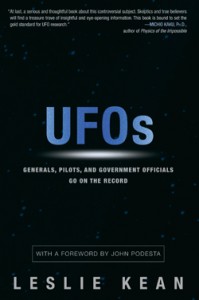 Finally a serious journalist has been able to garner some mainstream legitimacy for the subject of UFOs. Leslie Kean’s great new book UFOs: Generals, Pilots, and Government Officials Go On The Record is on the bestseller lists; and more importantly, the author is getting major media airtime (including MSNBC and the Colbert Report a few nights ago) and is doing a great job of representing herself and the subject. Read it.
And while you’re at it, rent James Fox’s great new documentary, I Know What I Saw, which covers much of the same material.
Being Seen Seeing: A Paranoid Thought Experiment
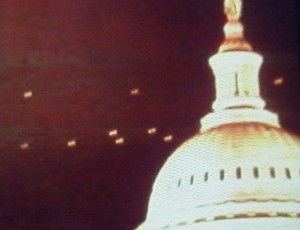 The second time I observed an aerial object that I could not identify was in the evening of August 3, 2009, on the Mall about four blocks from the Capitol building in Washington, DC. I was camped out with friends, part of the crowd attending the weekly “Screen on the Green,” and this evening the movie On the Waterfront was playing. Probably around 9:15, just about 20 minutes after the movie started, I saw a single bright light move from due North to due South, almost straight overhead and thus seemingly directly over the Capitol (although without knowing its altitude there is no way of verifying that). I watched it for about 10 seconds, and then it faded out.
Had it been a clear star-filled night away from the city, in the mountains, and had the light been far dimmer, I would have identified it as a satellite with a polar orbit (i.e., carrying it straight North to South). I’ve never seen a straight North-South satellite before, but I’m sure they exist. But in this case there was far too much light pollution for it to be a satellite. Only one bright planet and the moon were visible at that hour, and this object was as bright as that planet. As I said, the sighting lasted maybe ten seconds in all. I did not see it first appear, so I don’t know if it came into view over the skyline or faded into view somewhere overhead.
I didn’t say anything to anybody, and I suspect I was probably the only person on the Mall looking up at the gray sky and not at the movie at that moment. I had viewed my first “UFO” only a month before, in similar circumstances (camped out on a park in a city in the evening) so I was particularly attuned to the sky, and I even admit I had a very clear sense of expectation, that I might see something anomalous if I paid attention. So I was not really watching the movie. And as I said, that expectation paid off literally within 15 to 20 minutes of the start of the film.
I saw nothing else strange the rest of the night, although I was constantly watching. At one point I saw a helicopter low over the skyline, which was not out of the ordinary, but it did provide a base of comparison. It also reminded me that the airspace over Washington, DC is highly restricted. Planes aren’t allowed to fly over it. But what I saw did not resemble a plane.
I won’t deny that this light in the sky probably had a very prosaic explanation—I’m not assuming it was an alien probe or anything so exotic. But at the time, an idea arose that will seem paranoid: As I was watching this light, I wondered if it could also see me, and see that I alone, among all the people on the Mall right then, perhaps even among all people out at night in the city that evening (because people actually don’t look up very much), was watching it fly over. If the light were somehow an observation device observing the Capitol and the people gathered near it, and if it were the product of super-advanced technology (a lot of ifs, obviously), then might it not possess optical capabilities of vastly greater scope and resolution than what we would envision? Even our own satellites can now discern objects on the ground at a size of under a meter. What if an advanced alien probe had effectively an optical “skin,” viewing at high resolution in all directions, and with the image-processing, analytical, and recognition power to match its information-gathering sensitivity?
What if, to that probe flying high over the capitol, the faces and the eyes and even the pores on the skin of the hundreds of people camped out on the lawn, dimly illuminated by the light of the screen and the gray evening sky, were clearly viewed and registered and recorded? What if it could recognize those individuals? What if it could independently note and record what each of those individuals were doing?
So, what if that UFO saw me seeing it, saw me, alone among the throng, track it across the sky, registered my silently satisfied yet surprised expression, and immediately knew who I was from the fine-grained data it and its fellow probes had gathered on the city and the country and the species? What if it added such knowledge (“observed by Eric Wargo”) to its memory, and made a “mental note” that I was among the witnesses to its presence, and marked me for possible future added surveillance?
What if it even dimmed its lights (faded out) because it detected that it was being seen?
The baboon sees the biologist crouching behind the tree on yonder hill. The human has never hurt her, indeed has never come near, but out of instinctive cautiousness she picks up her baby and moves under the cover of trees, where she sits and continues pulling up roots from the ground. Never does it enter her baboon mind that that human, to her just a distant colorful shape, is watching her through binoculars, can see up close her every facial expression and tic of behavior, knows her identity and her whole history, when she was born, her rank in the troupe, etc., and even at that moment is taking notes on a laptop computer, adding her current activities to a database.
It’s not absurd to think that a remote witness to advanced surveillance technology would reciprocally be witnessed, would be seen seeing it, and that that piece of technology would be able to see and know more about the witness than the witness could possibly fathom. There are probably no limits to the watching and knowing capabilities of a piece of technology thousands or millions of years in advance of our own and having “deep anthropology” as its raison d’etre.
There are also no limits to the paranoia of the human mind, once it goes down the kind of slippery slope that UFOs and other paranormal phenomena encourage.