The Nightshirt Sightings, Portents, Forebodings, Suspicions
Wikileaks: Soviet UFO Investigations
The rumors about upcoming Wikileaks concerning UFOs seem to be true: In a newly released cable published in a Norwegian newspaper, the chairman of the intelligence service of the former Soviet Republic of Belarus revealed that during the time of the Soviet Union, there were extensive funds for investigating the UFO phenomenon.
Read the story here.
But this only confirms what was already known: That the Soviet government and military were as interested in UFOs as those of the U.S. And Russia continues to investigate the subject. Read Philip Mantle and Paul Stonehill’s research on UFOs behind the Iron Curtain.
“Tell me how you really feel about your flying saucer”
“Along with his freely and evenly hovering attention which enables the analyst to listen simultaneously on many levels, he needs a freely roused emotional sensibility so as to perceive and follow closely his patient’s emotional movements and unconscious fantasies.” Paula Heimann
When I first came across this quote about a psychoanalyst’s “freely and evenly hovering attention” (reproduced in Christopher Bollas’s book The Shadow of the Object), my mind immediately supplied an image of the doctor as a flying saucer, floating silently over a patient on a couch. I’m sure that’s not the metaphor the author had in mind, but it seems apt, and it seems like the metaphor could flow in both directions.
Jacques Vallee calls UFOs a control system, a thermostat regulating our psyches. Jung called them a material symbol of individuation that fascinates us at a time of high collective anxiety. The underlying idea is that UFOs, whatever else they are, may serve a therapeutic function, helping us in our process of evolution as individuals and as a species, and helping us move past our inner and outer conflicts.
Freud discovered that the key to curing people of their neuroses was the process he called “transference.” By saying very little—often maddeningly little—the doctor turns himself into a silent projection screen for the patient’s unconscious fantasies, and a stand-in for the earliest love objects in the patient’s life. The process of cure is getting the patient to recognize these fantasies and identify the object his present confusions and conflicts are really directed toward. As fits the stereotype, the “object” referred to by psychoanalysts, particularly those of the object-relations school, is generally the mother.
Transferrence is sometimes called “transference love” because the patient not only substitutes the doctor for the real love object but also expects or hopes for that love to be returned. The patient unconsciously hopes and believes the doctor secretly loves him back, and even “seduces” the doctor through his symptoms. The typical patient wishes to have the most interesting symptoms, to be the doctor’s most fascinating case.
A commonly expressed notion is that ETs are visiting us because they find humans particularly remarkable and unique, our civilization and our planet particularly rich and exciting. This goes right along with the Close Encounters fantasy: Their silence and elusiveness are really a big tease and preparation for the final big show of their love, where they will reveal at last the truths about ourselves and our special place in the universe that they have been keeping secret until we were ready to join them as equals. Along with this fantasy is the notion that, once they have disclosed themselves to us, we will put aside our childish squabbles and conflicts and set aside our petty materialistic strivings, and finally become a mature, rational, humane species.
Intellectually I think the notion that “they” have any particular love for us is naïve. I suspect theirs is no more than a professional concern, and that humanity is just one of their countless patients. But I confess that I can’t help but harboring in the back of my mind that same hope for a final disclosure—not from “the government” but from the ETs themselves—and the belief that these hovering, attentive doctors hold all the answers about us and could alleviate all our pains and help us resolve our conflicts.
Debunkers of the paranormal often recite the idea that people believe in things like UFOs because they crave some meaning in their lives. I think this is true. Who doesn’t crave some meaning in their lives? Who doesn’t want to believe? Even the attachment to science is, at bottom, an all-too-human faith in a solid foundation of meaning. When we have a crisis of faith, as we often do at a crossroads, we may swallow our pride and visit a doctor. Just because we go to the doctor to help us fill a hole in our lives doesn’t mean the doctor doesn’t exist. It’s just that our crisis has made us start to pay attention.
The Martians’ Horrific Geometry
“He talked of his dreams in a strangely poetic fashion; making me see with terrible vividness the damp Cyclopean city of slimy green stone—whose geometry, he oddly said, was all wrong…” H.P. Lovecraft, “The Call of Cthulhu”
A surprising number of features on Mars show qualities at least somewhat suggestive of having been sculpted not by wind, dust, and water, but by hand. The best known of these features is the famous “face,” gazing up from a symmetrical plateau in the Cydonia Mensae region in the planet’s northern hemisphere. Pictures of the face and other anomalous Martian features are objects of intense interest and analysis by a large Internet community united in the search for evidence of an ancient civilization on the Red Planet, and they are objects of intense disinterest by the Jet Propulsion Laboratory, the NASA contractor that sends the orbiters that take the pictures.
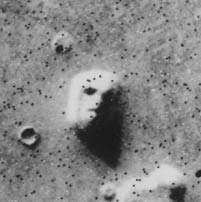 There are no smoking guns, for sure, but there are enough oddities that it is at least worth keeping an open mind to the possibility of ancient intelligent habitation of Mars, back when the planet was watery. Both those in favor and those opposed seem to agree at least on the terms of the debate—on the need to accurately interpret orbital imagery (angles of view and of illumination, understanding of imaging and data compression artifacts, etc.). Arguments for and against many of the features, for instance those of Cydonia, are made on the basis of a small set of qualities (or lack thereof) that we tend to regard as distinctive, or potentially distinctive, of artificiality: qualities like angularity, regularity, symmetry.
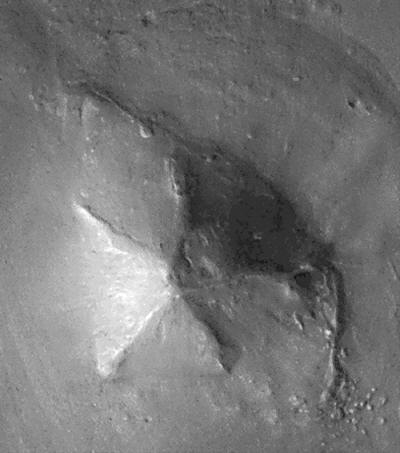 By these standards, numerous features in the vicinity of the face are kind of artificial looking—among them an apparent “complex” of suspicious five-sided pyramids and various straight walls that look distinctly like earthworks. The face also appears to possess the telltale geometry of manufacture: It is nearly bilaterally symmetrical, it is detailed (in more recent images the right “eye socket” has been shown to have an anatomically correct eyeball-like feature), and it rises straight up from an also-symmetrical plateau that bears striking resemblance to similar ancient artificial structures on Earth. Its deviations from symmetry are small enough that they could easily be the product of long weathering and erosion. (To explore this stuff, visit Mac Tonnies’ vast Web site, The Cydonian Imperative.)
I can’t help but wonder, though: To what extent is the search for extraterrestrial civilizations on Mars, or anywhere, biased by presumptions that ETs will, like us, prefer things like straight lines, symmetry, regularity? To what extent are we biased to see Euclidean forms (which do also occur in nature) as signs of intelligence, and to what extent might we fail to see intelligent design in objects and structures that have an organic, “natural” appearance?
Such a bias would be understandable given that, at least on our planet, Euclidean geometry was born hand in hand with civilization. All the things we associate with civilization arose from the imperative to more efficiently structure human ecology in conditions of dwindling resources and dwindling space—from getting more calories from a given unit of land (think of linear rows of tightly packed cornstalks vs. the wide, haphazard distribution of wild animals and plants that fed paleolithic nomads) to just plain fitting more people into more tightly packed settlements. Rectangular dwellings supplanted the circular, ovular, or irregular dwellings of Paleolithic peoples because you can fit rectangles together more tightly. The clay and stone cities of the world’s first civilizations are organized in squares and rectangles. You could say civilization’s “footprint” is the rectangle.
In other words, exerting our dominion over the plants and animals meant imposing on nature’s fractal geometry a grid instead. All our inventions, from horse-drawn carts to cars to books to silicon chips, reflect the fact that energy, matter, and information seem to be most efficiently structured through the use of straight lines and right angles, producing symmetrical forms. This rejection of nature’s fractal geometry launched us on the path to trade, mathematics, writing, science, and technology.
So on one hand, it might be reasonable to suppose that civilizations arising elsewhere will have done so out of the same imperatives, and thus will have developed a similar taste for the Euclidean. Yet it is certain that our technology, and thus our lifestyles, will ultimately depart from the Euclidean and return to the fractal, and this departure will happen sooner than we may anticipate. Space allows you to sprawl again, for one thing; and the shape of things to come, so to speak, is technology that is grown rather than manufactured. Machines will be organic and self-replicating, humans will be biomechanical. The distinction between natural and artificial may ultimately vanish altogether—or at least will appear so when viewed from afar. We are close to this threshold, and it is probable that any alien civilization we come across will have already crossed it.
Thus when trying to imagine the built environments of alien civilizations I find something somehow more realistic about the organic biomechanical worlds envisioned by artists like H.R. Giger. Giger’s “biomechanoid” environments merge machine and nature, creating a world that has transcended the Euclidean, where technology resembles bones, intestines, and genitals more than it resembles machines with moving parts, and where the living and nonliving seem to enjoy almost a parasitical or even sexual interrelationship. It’s a vision that lends itself to horror: It’s no accident Giger was inspired by H.P. Lovecraft, who described ancient gods slumbering in slimy non-Euclidean cities. Giger’s horrific images in turn inspired Ridley Scott when envisioning his sci-fi masterpiece Alien.
I think it’s because I find Giger’s vision so realistic as well as so beautiful that I’m less startled or moved by the boringly geometrical, symmetrical, Euclidean pyramids and face of Cydonia than I am by the photo below. Since this image was noticed and published by anomalist Richard Hoagland in 2000, features looking like gigantic ribbed, glassy “tubes” have been found various places on Mars, including Cydonia, and have provoked much speculation in the Mars anomaly community. Arthur C. Clarke even weighed in on this image, saying “It’s one of the most incredible images that’s ever come from space.”
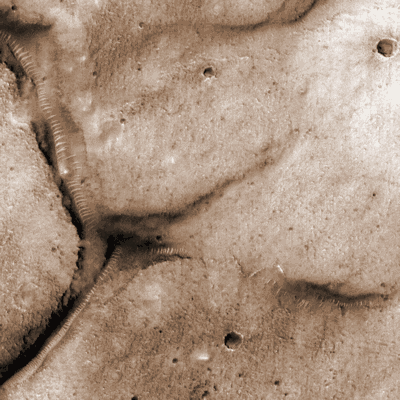 At the time, Clarke was flabbergasted that no official explanation of the feature had been offered. Ultimately the Jet Propulsion Laboratory said that these “tubes” were actually concave rather than convex features—wave-like rippling of dust at the bottom of ravines. (It is notoriously hard to tell whether surface features are “innies” or “outies” when photographed from space.) Most of them are very difficult to see as concave, however, and anomalists have interpreted them as anything from remnants of glass water pipelines or subway systems to gigantic living forms themselves, akin to Frank Herbert’s sandworms.
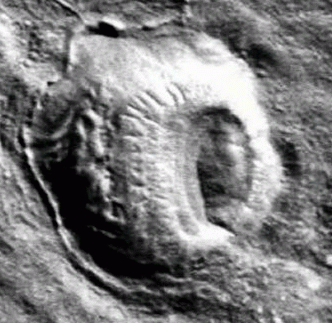 The tubes definitely call to my mind something out of the world of Giger: Relics of an ancient, labyrinthine, biomechanoid construct—perhaps an organic habitat for a dying underground race, or perhaps a singular rhizome-like being unto itself, enjoying an almost lascivious relationship to its planet. (Mac Tonnies drew a similar analogy to Giger regarding a very organic-looking, even lewd “orifice”-like feature seen in another satellite photo—right.)
Whatever the tubes are, they ain’t regular. It is ironic that Clarke, whose own iconic interplanetary artifact is the most rectilinear, unmistakeably “artificial” object possible—the lunar slab in 2001—would wax thunderstruck not at the face or any of the many suspiciously geometric objects (including apparent “monoliths”) that have been photographed on Mars, on the Moon, and elsewhere in space, but at a feature that bears far more resemblance to something from the homeworld of Alien’s fossilized star pilot.
I don’t know what the tubes really are—maybe they are natural, and maybe they are an optical trick—but I’m still with Clarke. Of all the cool and weird space pictures I’ve seen, it’s the “worms” that fill me with the most awe, the most intense curiosity, and even the most apprehension. I want to know—yet am almost afraid to know—what beings may have dwelled under the surface of Mars in, as Lovecraft might have put it, the ages before there were men.
STS-80
Several compelling pieces of visual evidence for UFOs come from videos taken in orbit by Space Shuttle crews. NASA typically doesn’t comment on these videos, and when they do, they explain them as dust, space junk, or ice coming off the orbiter. They are surely right in many cases—numerous such videos posted on YouTube as UFOs are clearly not. But a few videos stand out from the rest, particularly two video sequences shot aboard the Columbia during mission STS-80 in September, 1991. Both appear in the video clip embedded below. (This video is clearly extracted from a documentary; if anyone knows the identity of the documentary, or of the narrator, please let me know!)
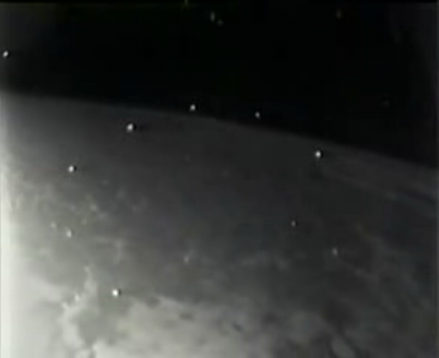 The first sequence shows several objects appearing behind and below the shuttle, gradually taking on a circular formation. Most of the objects do not follow a straight trajectory. The object moving from right to left in the upper part of the screen (and not entering the circle) actually curves up as it gets farther away, rather than down (which it would have to if it were following an orbital path over the horizon). Lastly a bright object materializes in the center of this circle.
In the second sequence, several objects approach or simply materialize over a lightning storm in the atmosphere below. Again, they do not move in a straight orbital trajectory. The narrator thinks UFOs draw their energy from electrical discharges in the atmosphere; that’s total speculation, although his observation that orbital UFOs seem to swarm around such storms is interesting—this sequence does seem to show such swarming.
The second sequence in the video appears to be the encounter with a large spinning disc described in a recent article in The Canadian that at least one Columbia crewmember openly acknowledged witnessing:
The disc was first observed to miraculously appear from out of nowhere, flying through the clouds below and progressing from right to left as the astronauts stared in utter amazement. The outer rim of the craft appeared to be rotating counter-clockwise. It was very large (compared to common space junk and breakaway ice), approximately 50 to 150 feet in diameter.
Astronaut Dr. Story Musgrave, a Payload Specialist on the STS-80 Mission, was interviewed following the flight. As he viewed a videotape of the incident which showed lightning flashes in the atmosphere, the city lights of Denver, Colorado and other earthbound sights, he stated: “I don’t know what it is. Whether it’s a washer, debris, ice particles, I don’t know. But it’s characteristic of the thousands of things which I’ve seen. What is not so characteristic is it appears to come from nowhere.
The full-length video of this second encounter can be found in full, without narration, on YouTube.
Since retiring, Musgrave, like other retired astronauts (Buzz Aldrin, Dr. Edgar Mitchell, Gordon Cooper, for example), has been outspoken in his belief in ET visitation.
Beautiful Moons
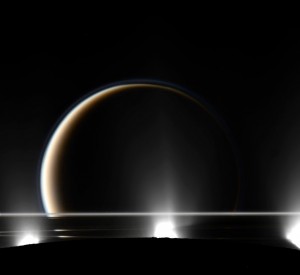 The horizon of Saturn’s moon Enceladus, with the ringed moon Titan in the background, shot by the Cassini probe. The plumes are geysers.
See story and full-size image at the Planetary Society website.
A Control System (The Right to Bear Experience, Part Deux)
A theme running through all of Jacques Vallee’s writings, and expressed beautifully in my favorite of his books, The Invisible College
I think the modern anxiety is deeper than war, and also deeper than technology. It is commonly said that our technology has outstripped our moral consciousness, and this is certainly true. But while we may sometimes be struck with awe at the technology we’re compelled to take for granted (space flight, the Internet, iPhones…), I think the anxiety, and needed psychic course correction, has to do more fundamentally with the alienation from our experience that science itself, as the new world religion, can instill.
I wrote a while back about Forteana as a response to the scientific invalidation of personal experience. Now, on rereading The Invisible College, I think that this might relate to the kind of psychic and cultural course correction Vallee is talking about. UFOs (as well as Bigfoot, ghosts, and other paranormal phenomena) grasp hold of our imagination at a time when our culture and media are inundated with scientific research undermining everything we believe about ourselves.
My day job is in the behavioral sciences, and am gratified to see that kind of research finally making headway into mainstream culture. Yet I am also constantly troubled by the way the scientific study of human behavior by definition (definition of science, that is) invalidates human experience as an “n of 1.” The metamessage of psychology is that you—you individual person, naturally thinking you understand yourself—are actually in complete ignorance about your real motives, your real emotions, your real thoughts. You don’t know the real reasons for the things you do.
In this world where the dominant worldview is that our experience is wrong, UFOs and Bigfoot represent secular champions that might win the epistemological wrestling match against cold, impersonal, invalidating science, whose method reduces the individual to a data point. Fascination with “close encounters” and other such phenomena is a way of asserting, against science, the right to bear our personal experience (on analogy with the individual right to bear arms). The resurgence of Christian fundamentalism emphasizing a personal relationship with Christ can probably be seen in the same terms.
It is often said that true believers in UFOs (and Bigfoot and whatnot), despite their clamoring to get science and the media to take the phenomena seriously, actually don’t want the status quo to change because then they’d stop having their faith; it would be replaced by fact. I think this is true: Once there is some kind of Disclosure about the UFO reality—which is inevitable given that sooner or later, in our age of camera phones, etc., there will be a mass, well-documented, well-filmed sighting that leads to popular pressure on the government—the phenomenon will suddenly become legitimate in the scientific world, and it will be like it has been snatched away from us.
I suggested in an earlier post that UFOs are a perfect symbol in the American Gnostic religion and that this will be increasingly true as UFOs become more accepted in mainstream science. I think I was exactly wrong on that. Science will invalidate them as symbol, and at that point the individual and collective mind will need to find a new control mechanism.
Go SpaceX
Sweet launch and POV video of yesterday’s Falcon 9 flight:
(If you want to skip ahead to the separation of Stage 1–everyone’s favorite part!–it happens about 4 minutes in.)
UFOs and the Midlife Crisis
I’ve obviously been thinking a lot about UFOs in the last couple months—duh—so out of a sense of blogging duty I thought I should get out my DVD of Close Encounters and watch it again, and perhaps comment on it. It has been a couple years.
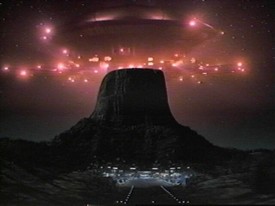 I totally disagree with Spielberg’s overt premise—that ETs are gearing up for a great big contact event where they finally reveal themselves to us as wise and benevolent cosmic tricksters. But I still love pretty much everything about the film, and even confess to be moved by the typically sugary-happy Spielberg ending. It’s a wonderful, exciting, and at times awe-inspiring film.
My favorite way to interpret any sci-fi film is to squint my eyes and remove the sci-fi aspect, imagine the film without it. Squinting, I had always sort of seen Close Encounters being as much about art and the creative process as it is about alien visitors. Roy Neary’s UFO-induced “inspiration” and his subsequent idée-fixe about a tower in the desert leads him gradually to realize his vision in sculpture—a process that is exactly (well, minus the UFO part) like the process of creating any artwork like a painting or a film or a novel. Art is a process of getting inspired and driven to work through a creative problem, often at the expense of family and personal relationships; it never lets you go until you stand back, dirt all over your clothes and hair tousled, and, like God at the end of Creation, finally see the thing you’ve made as good.
This time the latter theme struck me even more forcefully, but I also realized that the art aspect is just part of a bigger theme that lurks underneath everything else in the film. What’s left, if you really squint your eyes at Close Encounters, is the story of a man’s midlife crisis in all its aspects—sometimes ugly, sometimes pathetic, but also heroic (and not just in a Joseph Campbell hero-journey way).
 At the start of the film, Roy Neary is a husband and father pulled in a million directions—four loud and unruly kids, a hectic and not-very-fulfilling job, a loving but conventional and occasionally shrill wife, and the growing gnawing ache that comes to a man when age and the first intimations of mortality first start creeping into his consciousness. It drives a man, even without his being aware of it, to seek something more, to grow in some new way. The stereotype is that men going through such crises buy sports cars and leave their wives for girls half their age. Usually it’s not quite so picturesque, but it’s still disruptive.
A man often takes up new hobbies like art. Feeling drawn in different directions he may neglect his job or even run the risk of losing it. He becomes irritable and chafes at his family duties and feels increasingly alienated from his wife. He may become a jerk or asshole to her, and she may increasingly see him as a child, be embarrassed by him, and urge him to get help or suggest seeing a counselor together. They often get separated, at least for a time, while he works out his issues.
He may feel an urge to be alone and hit the open road. He may not have a full-on extramarital affair, but he often finds connection in some platonic relationship with a woman who somehow seems to understand him better than his wife does—who grasps and appreciates the new self he is vaguely struggling to become. All through this he will be feeling great psychic pain and be desperate to understand what is happening to him.
These things are exactly what Roy does in the film.
It’s a not-widely-remembered fact that it was Carl Jung who first identified the midlife crisis as a stage in development. And I was frankly stunned by what a Jungian film Close Encounters is. In fact, it goes right along with Jung’s views on UFOs too. Jung didn’t deny the likely physical reality of flying saucers, whatever they are and wherever they originate (and he was vocal on the need for governmental disclosure). But as a psychologist he was interested in the way UFOs are also a projection screen for the unconscious. He said they likely manifest themselves (or are especially noticed) at times when society feels great anxiety and is at some crossroads.
This response to societal anxiety is mirrored in the response to anxieties on the individual level. Those in the grip of crisis, feeling a drive to grow toward individuation and wholeness, dream of and notice in their lives recurrent symbols of that wholeness, typically in the form of circular shapes or mandalas. In our age, what fits the bill for that better than flying saucers? He developed his argument through the analysis of numerous dreams about UFOs his patients had had. (I’ve had a million of those dreams, and I’m no stranger to midlife crises…)
At the culmination of Spielberg’s film, Roy, aided by the similarly lost and seeking Jillian, reaches his destination—he finds the reality he was gropingly trying to learn about and express in his art hobby. Could Jung have come up with a better way to symbolize the end of a man’s midlife crisis than having him enter a giant mandala that has descended in the desert?
Here’s to all our crises ending so spectacularly.
“Strange Days Indeed”
It’s the anniversary of John Lennon’s death. Few people know that in 1974, the former Beatle, his then-lover May Pang (he was separated from Yoko at the time), and many other New Yorkers watched a huge flying saucer hover for several minutes over the East River, near his apartment on 52nd Street.
 Subsequently Lennon felt that acceptance of UFOs would lead to a revolution in the way people saw themselves, and a revolution in society.
Bryce Zabel has a nice article about Lennon’s amazing experience at the After Disclosure site.
Vallee on Salon
 The always fascinating Jacques Vallee has just published (with Chris Aubeck) a catalogue of 500 historical accounts
“A delusion is usually single-witness and there are many multiple-witness cases in the book. You also have authority figures, astronomers and well-known people making claims. You have Michelangelo seeing a triangle with three lights of different colors in the sky and making a painting of it. It’s staggering when you hear modern scientists saying only idiots and crazy people report UFOs.”
[update 12/8: There’s a terrific new audio interview with Vallee on his career and recent work here]